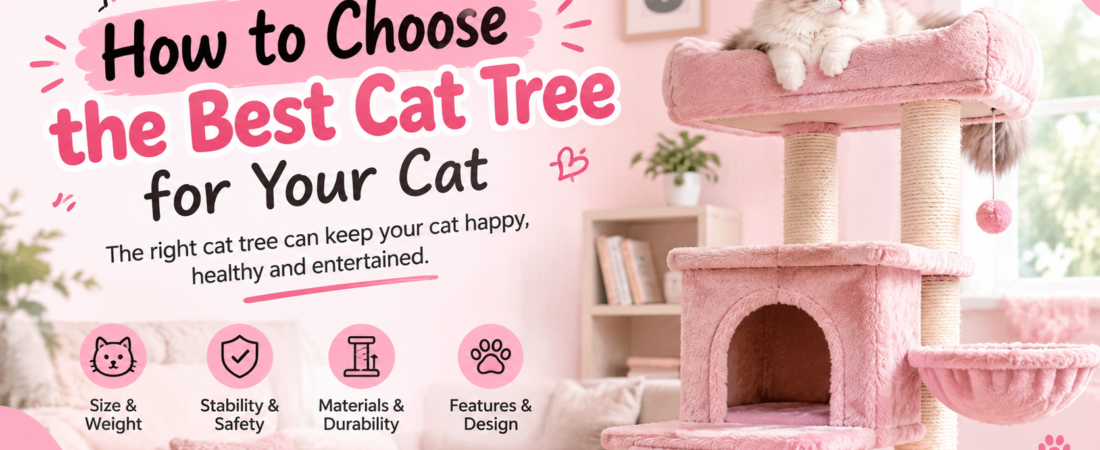
A cat tree can be much more than a place for your cat to sleep.
For indoor cats, a well-designed cat tree can provide opportunities to climb, scratch, hide, observe the room, and rest. It can also help make a home more interesting for cats that spend most of their time indoors.
But choosing the right cat tree isn’t as simple as picking the tallest or most attractive model.
The best cat tree depends on your cat’s size, age, activity level, personality, and the amount of space available in your home.
In this guide, we’ll explain what to look for when choosing a cat tree and how to avoid common mistakes.
Why Do Cats Like Cat Trees?
Cats naturally enjoy elevated spaces.
Being up high allows them to observe their surroundings while feeling relatively safe and undisturbed. A cat tree can provide this opportunity inside the home.
A good cat tree may give your cat several useful areas in one structure:
- A place to climb
- A scratching surface
- An elevated sleeping area
- A hiding space
- A place to observe the room
- A play area
For indoor cats, these activities can add variety to their daily environment.
If your cat spends most of the day indoors, you may also want to read our guide to Indoor Cat Enrichment Ideas.
What Size Cat Tree Should You Buy?
Size is one of the first things you should consider.
A cat tree that looks large in a product photo may actually have relatively small platforms.
Before buying, check the actual dimensions of:
- The overall height
- The base
- Individual platforms
- Sleeping areas
- Condos
- Scratching posts
- Distance between levels
Your cat should be able to comfortably stand, turn around, lie down, and move between levels.
For a small kitten, a compact cat tree may be perfectly adequate.
A large adult cat, however, may quickly outgrow a lightweight model with tiny platforms.
If you have a larger cat, see our Best Cat Trees for Large Cats guide.
How Tall Should a Cat Tree Be?
There is no universally perfect height.
A shorter cat tree can work well in a small apartment or for an older cat that doesn’t enjoy climbing very high.
A taller model can be more appealing to an active cat that enjoys climbing and observing the room from an elevated position.
When choosing a tall cat tree, stability becomes especially important.
The higher the structure, the more important it is that the base is wide and the overall construction is stable.
A tall cat tree that wobbles when your cat jumps onto it is not a good choice, regardless of how impressive it looks.
Stability Is More Important Than Height
This is one of the most important things to check before buying a cat tree.
Cats can jump onto platforms at considerable speed. A lightweight or poorly balanced structure may move, tip, or become damaged over time.
Look for:
- A wide and heavy base
- Strong connections between levels
- Thick support posts
- Secure platforms
- A design that doesn’t wobble during normal use
Some tall cat trees also include wall-anchoring hardware.
If a product provides an anti-tip strap or wall anchor, use it according to the manufacturer’s instructions.
A stable 5-foot cat tree is better than an unstable 6-foot cat tree.
What Materials Are Best for a Cat Tree?
Most cat trees combine several materials.
Common materials include:
- Engineered wood
- Particleboard
- Sisal rope
- Carpet or fabric
- Plush materials
- Faux fur
The materials themselves don’t tell the entire story.
Construction quality matters just as much.
A cat tree with thick scratching posts and sturdy connections may last much longer than a larger model made with weaker components.
Scratching Posts
Sisal-covered posts are particularly common because they provide a surface cats can scratch.
Check the diameter and height of the scratching posts.
A post that is too short may not allow your cat to fully stretch while scratching.
If scratching behavior is a major concern, you may also want to explore Best Cat Scratching Posts.
Platform Size Matters
Many cat trees look impressive because they have multiple levels, but the individual platforms may be surprisingly small.
This can be a problem for larger cats.
A platform should provide enough room for your cat to sit or lie down comfortably.
For heavier cats, pay particular attention to the manufacturer’s recommended weight capacity.
Don’t assume that a tall cat tree is automatically suitable for a large cat.
Platform size and structural strength matter just as much as height.
Cat Trees for Large Cats
Large cats need more than a tall structure.
They often need:
- Larger platforms
- Wider scratching posts
- Stronger supports
- A heavier base
- Larger sleeping areas
- Higher weight capacity
A cat tree designed for a small adult cat may not provide enough room for a Maine Coon or another large breed.
If your cat is particularly large or heavy, prioritize stability and platform dimensions over the number of levels.
Read our Best Cat Trees for Large Cats guide before choosing a model.
Cat Trees for Kittens
Kittens are naturally curious and energetic.
A cat tree can give them a safe place to climb and explore, but extremely tall structures may not always be appropriate for very young kittens.
Look for a model with:
- Stable construction
- Lower platforms
- Easy access between levels
- Secure resting areas
- Appropriate spacing between platforms
As your kitten grows, you can upgrade to a larger structure if necessary.
Cat Trees for Senior Cats
Older cats may still enjoy elevated spaces, but they may not be able to jump and climb as easily as younger cats.
For senior cats, consider a cat tree with:
- Lower platforms
- Shorter jumps between levels
- Wide steps
- Easy-to-access sleeping areas
- Stable construction
You don’t necessarily need to eliminate vertical space.
Instead, make sure your cat can reach the preferred resting area without difficult jumps.
How Many Levels Does a Cat Tree Need?
More levels do not automatically mean a better cat tree.
A cat tree with five platforms isn’t necessarily more useful than one with three well-designed platforms.
Think about what your cat actually likes to do.
If your cat mainly wants a high observation point, one tall perch may be more valuable than several small platforms.
If your cat loves climbing and exploring, multiple levels can provide more opportunities for activity.
The best design is the one that matches your cat’s behavior.
Should a Cat Tree Have a Condo?
Many cat trees include enclosed condos or hiding areas.
These can be useful for cats that enjoy privacy.
Some cats love sleeping inside enclosed spaces, while others never use them.
Don’t pay significantly more for a condo simply because it is included.
Look at your cat’s existing behavior.
If your cat frequently sleeps underneath furniture or inside boxes, an enclosed cat-tree condo may be particularly appealing.
Where Should You Put a Cat Tree?
Location can determine whether your cat actually uses the cat tree.
A beautiful cat tree placed in an isolated corner may receive very little attention.
Many cats prefer locations where they can observe what’s happening around them.
Good locations may include:
- Near a window
- In a room where the family spends time
- Near a favorite resting area
- Away from heavy foot traffic
- Somewhere with an interesting view
A window-facing location can be especially attractive because cats can watch birds, people, and outdoor activity.
However, avoid placing the cat tree somewhere that could create a fall hazard or interfere with doors and walkways.
How to Encourage Your Cat to Use a New Cat Tree
Some cats immediately climb onto a new cat tree.
Others completely ignore it.
If your cat doesn’t use it immediately, don’t assume the product is a failure.
Try placing familiar bedding on one of the platforms or using a small amount of catnip if your cat responds to it.
You can also place toys near the structure or reward your cat for exploring it.
Most importantly, don’t force your cat onto the tree.
Allowing your cat to investigate it naturally is usually a better approach.
Cat Tree vs. Cat Scratching Post
These products serve overlapping but different purposes.
A scratching post is primarily designed for scratching, stretching, and marking behavior.
A cat tree combines scratching with climbing, resting, and observation.
If space or budget is limited, a well-designed cat tree with sturdy scratching posts can provide multiple functions.
However, some cats strongly prefer a dedicated scratching post.
There is nothing wrong with having both.
You can learn more in our Cat Scratching Guide.
Common Cat Tree Buying Mistakes
Choosing Based Only on Appearance
A cat tree can look beautiful in a product photo while being too small or unstable for your cat.
Buying the Tallest Model Available
Height isn’t useful if the structure wobbles or the platforms are too small.
Ignoring Weight Capacity
Always check the manufacturer’s recommended weight range.
Forgetting About Platform Dimensions
A large overall structure can still have tiny sleeping platforms.
Buying Without Measuring Your Space
Measure the area where you plan to place the cat tree before ordering.
Remember to consider ceiling height, nearby furniture, doors, and walking space.
Assuming Your Cat Will Automatically Use It
Cats have individual preferences.
A new cat tree may need time and encouragement before becoming part of your cat’s routine.
How Much Should You Spend on a Cat Tree?
Cat trees can range from relatively inexpensive compact models to large premium structures costing several hundred dollars.
Price alone does not tell you whether a particular model is good.
Instead, compare:
- Materials
- Stability
- Platform size
- Scratching-post quality
- Weight capacity
- Construction
- Replacement parts
- Customer feedback
- Warranty or return policy
For a cat tree that your cat will use every day, spending a little more for better stability and construction can make sense.
But there is no reason to pay extra for features your cat is unlikely to use.
Final Thoughts
The best cat tree isn’t necessarily the tallest, largest, or most expensive one.
It is the one that matches your cat.
Before buying, consider your cat’s size, age, activity level, climbing ability, scratching habits, and preferred sleeping locations.
Then look at the practical details: stability, platform size, scratching-post quality, materials, weight capacity, and overall dimensions.
If you are buying a cat tree for a large cat, start with stability and platform size. If you have a senior cat, prioritize accessibility. If you live in a small apartment, focus on vertical space without sacrificing stability.
For product recommendations and detailed comparisons, explore our Cat Trees section and check out our latest Cat Tree Reviews.