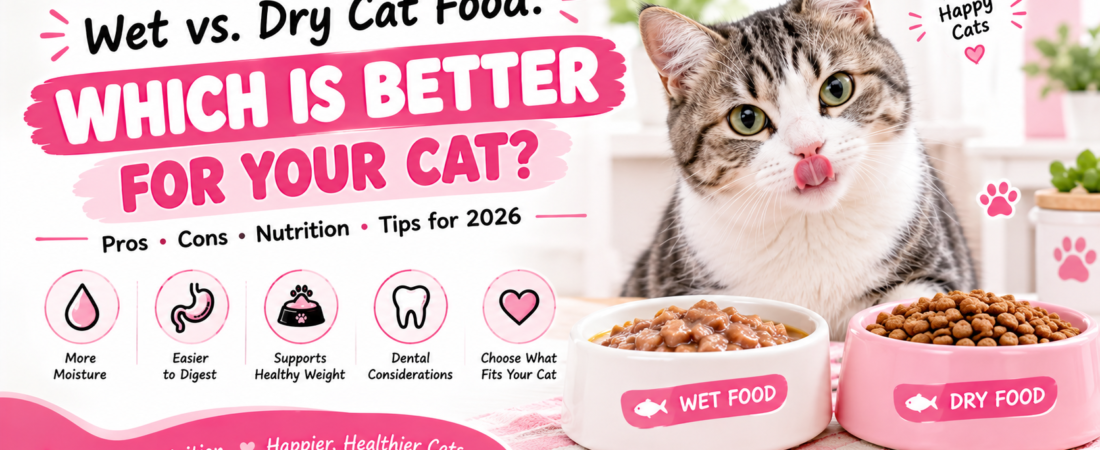
Choosing the right food is one of the most important decisions you make for your cat. With so many options available, one common question is whether wet or dry cat food is better.
Wet cat food is known for its high moisture content and soft texture, while dry cat food is convenient, easy to store, and often more economical. Both can provide essential nutrients when formulated as complete and balanced diets for the appropriate life stage.
So, which option should you choose?
In this guide, CatJoyLife compares wet vs. dry cat food, explains the benefits and drawbacks of each, and shows you how to choose a feeding routine that fits your cat’s needs, your budget, and your lifestyle.
1. What Is Wet Cat Food?
Wet cat food usually comes in cans, pouches, or trays. It contains substantially more water than dry food, often around 70–80%, although the exact amount varies by product.
Common types include:
- Pâté
- Chunks in gravy
- Shredded meat in broth
- Mousse
- Stew-style meals
Wet food can be particularly useful for cats that do not drink much water or prefer a soft texture. However, the nutritional value depends on the specific formula, not simply whether the food is wet.
Pros of wet cat food
1. Higher moisture content
Wet food contributes water to your cat’s daily intake. This can be helpful for cats that naturally drink little, although it does not replace access to fresh drinking water.
2. Often appealing to picky eaters
Its aroma and texture may encourage some cats to eat, particularly those that dislike hard kibble.
3. Often lower in calories per gram
Because wet food contains more water, many wet formulas have fewer calories per gram than dry food. However, calorie content varies, so compare the feeding label rather than assuming every wet food is low-calorie.
4. Easier for some cats to chew
Soft food may be more comfortable for cats with certain dental or chewing difficulties, but cats with mouth pain still need a veterinary examination.
Cons of wet cat food
- It often costs more per calorie than dry food.
- Opened portions need appropriate refrigeration and timely disposal.
- Food left in the bowl may spoil, particularly in warm weather.
- Measuring and storing multiple small portions may take more effort.
Best for: Cats that prefer soft food, cats needing additional dietary moisture, and owners who can manage portioning and storage.
2. What Is Dry Cat Food?
Dry cat food, commonly called kibble, contains relatively little moisture, often around 6–10%. It is generally sold in bags of different sizes and comes in a wide range of formulas.
Dry food can provide complete nutrition when the product is appropriately formulated and labeled for your cat’s life stage.
Pros of dry cat food
1. Convenient storage
Unopened kibble is generally easy to store, and dry food does not require refrigeration before opening when handled according to the label.
2. Often more economical
Dry food frequently costs less per calorie than wet food, although prices vary by brand and formula.
3. Easy to measure
A kitchen scale can help you portion food consistently and track daily calorie intake.
4. Useful for feeding routines
Dry food can work well with scheduled meals or appropriate automated feeders. Leaving food available all day, however, can make calorie control more difficult for cats that overeat.
Cons of dry cat food
- It provides much less moisture than wet food.
- Some cats may consume less total water when eating an all-dry diet, although individual drinking habits vary.
- Free-feeding can contribute to excess calorie intake and weight gain.
- Ordinary kibble should not automatically be considered a dental-cleaning food. Only certain specifically designed dental diets have demonstrated dental benefits.
Best for: Owners who value convenience, cats that enjoy kibble, and households that need an easy-to-measure feeding routine.
3. Wet vs. Dry Cat Food: Key Differences
The following table summarizes the main differences.
| Feature | Wet Cat Food | Dry Cat Food |
|---|---|---|
| Moisture | High, commonly 70–80% | Low, commonly 6–10% |
| Storage before opening | Depends on packaging; follow label | Usually convenient at room temperature |
| Storage after opening | Refrigerate as directed | Seal and store in a cool, dry place |
| Cost per calorie | Often higher | Often lower |
| Texture | Soft, moist | Crunchy |
| Portion control | Requires attention to serving size | Easy to weigh; free-feeding may encourage overeating |
| Hydration support | Adds substantial dietary moisture | Provides little dietary moisture |
| Dental benefits | Not a dental-cleaning method by itself | Ordinary kibble does not automatically clean teeth |
| Suitable for complete nutrition | Yes, if labeled complete and balanced | Yes, if labeled complete and balanced |
Neither type is automatically healthier. The best choice depends on nutritional completeness, calorie intake, your cat’s preferences, and any medical requirements.
4. Which Is Better for Hydration?
One of the biggest differences between wet and dry food is water content.
Cats evolved from ancestors adapted to relatively dry environments, and some domestic cats do not drink large amounts of water voluntarily. Wet food can increase water intake because your cat receives moisture while eating.
This may be particularly relevant for cats with certain urinary tract conditions or kidney disease. However, diet selection for these conditions should be discussed with a veterinarian.
Ways to support hydration
- Provide clean, fresh water every day.
- Place water bowls in convenient, quiet locations.
- Consider a water fountain if your cat prefers moving water.
- Offer wet food if it suits your cat’s nutritional needs.
- Monitor changes in drinking and urination.
Do not assume that wet food alone will prevent urinary disease or kidney problems. These conditions have different causes and may require specific veterinary treatment.
For more information about nutrition, explore Best Cat Food for Indoor Cats in 2026: Complete Feeding Guide.
5. Which Is Better for Weight Management?
Neither wet nor dry cat food guarantees a healthy weight. Total calorie intake, portion size, activity level, age, and individual metabolism all matter.
Wet food may provide a larger volume of food for the same number of calories because it contains more water. This can help some cats feel that they are eating a satisfying portion.
Dry food is more calorie-dense by weight, so a seemingly small serving can contain a substantial amount of energy.
How to manage portions
- Check the calorie content on the packaging.
- Use a kitchen scale to measure food accurately.
- Follow your veterinarian’s feeding recommendations when available.
- Count treats as part of your cat’s daily calorie intake.
- Monitor body condition and weight over time.
If your cat needs to lose weight, avoid crash diets or suddenly reducing food drastically. Cats that eat too little can develop serious health complications. Ask your veterinarian for a safe weight-management plan.
Read Best Cat Food for Weight Management in 2026 for more guidance.
6. Is Wet or Dry Food Better for Kittens?
Kittens grow quickly and need a diet that supports development. The most important factor is choosing food labeled as complete and balanced for growth or for all life stages, according to the applicable nutritional standards.
Both wet and dry kitten food can be appropriate when properly formulated.
Wet food for kittens
- Offers a soft texture that many kittens readily accept.
- Contributes moisture to the diet.
- Can make it easier to offer small, frequent meals.
Dry food for kittens
- Is convenient to measure and store.
- Can be used in feeding routines suited to the kitten’s age and development.
- Should be offered in a formula suitable for growth.
Very young kittens may have different feeding requirements from older kittens. Orphaned kittens and kittens not yet fully weaned require specialized care and should not simply be fed ordinary adult cat food.
Important: Do not choose food solely based on whether it is wet or dry. Check its life-stage suitability and speak with your veterinarian if your kitten has diarrhea, poor growth, or difficulty eating.
7. Can You Feed Your Cat Both Wet and Dry Food?
Yes. Many cats can eat a combination of wet and dry food, provided both foods are suitable for their needs and the total daily intake is properly controlled.
Mixed feeding can offer several advantages:
- Wet food contributes dietary moisture.
- Dry food provides convenience.
- Different textures may make meals more appealing.
- Owners can adjust the balance to fit their budget and routine.
How to combine wet and dry food
Step 1: Calculate the daily calorie target.
Your cat’s ideal intake depends on factors such as weight, age, activity, and health. Your veterinarian can help determine an appropriate target.
Step 2: Check the calories in each food.
Read the packaging carefully. Do not replace wet food with an equal weight of dry food because their calorie densities can differ significantly.
Step 3: Divide the daily allowance.
For example, you might provide wet food at one meal and dry food at another. The exact ratio should reflect your cat’s needs rather than a universal formula.
Step 4: Monitor your cat.
Observe appetite, stool quality, weight, and tolerance to the new routine.
Step 5: Transition gradually.
Introduce new foods over approximately 7–10 days when practical, adjusting the pace if your cat has a sensitive stomach. Cats that refuse food or have persistent digestive symptoms need veterinary advice.
Remember that treats and snacks also contribute calories.
8. How to Choose the Best Cat Food
Instead of relying on marketing claims, use these criteria to evaluate wet and dry foods.
1. Look for a complete and balanced formula
Choose food that is nutritionally complete for the appropriate life stage. Some products are intended only for supplemental feeding or occasional treats and should not serve as the sole diet.
2. Check the life stage
Kittens, adults, and senior cats may have different nutritional needs. A food labeled for adult maintenance is not necessarily suitable as the sole diet for growing kittens.
3. Compare calories
Check the calorie content per can, pouch, cup, or kilogram. This helps you compare products fairly and manage portion sizes.
4. Consider your cat’s preferences
A nutritionally appropriate food is only useful if your cat will eat it. Texture, aroma, and flavor preferences vary between cats.
5. Consider health conditions
Cats with urinary disease, kidney disease, diabetes, food allergies, or other medical problems may need a specific diet. Ask your veterinarian before selecting a therapeutic diet or making major changes.
6. Evaluate your budget
Compare the cost per day or per calorie rather than just the price of a package. A larger bag or multipack may appear cheaper but still needs to fit your cat’s nutritional needs and storage requirements.
For a product-specific example, see IAMS Proactive Health Healthy Adult Cat Food Review.
9. Common Mistakes When Choosing Wet or Dry Cat Food
Avoid these common feeding mistakes:
Choosing based only on price. A low price does not tell you whether a food is nutritionally complete or suitable for your cat.
Ignoring portion size. Even an appropriate food can contribute to weight gain if you feed too many calories.
Assuming all wet food is healthier. Moisture content is an advantage, but overall nutrition and suitability matter too.
Assuming dry food cleans teeth. Ordinary kibble is not a substitute for tooth brushing or veterinary dental care.
Changing foods too quickly. Abrupt changes can upset some cats’ digestive systems.
Ignoring changes in appetite. A cat that suddenly refuses a familiar food may be unwell rather than simply picky.
Leaving wet food out for too long. Follow the product’s storage directions and discard food that has been left out beyond the recommended period.
10. How to Transition Your Cat to a New Food
A gradual transition can help many cats adjust to a new diet.
A general schedule might look like this:
| Period | Suggested approach |
|---|---|
| Days 1–2 | 75% current food, 25% new food |
| Days 3–4 | 50% current food, 50% new food |
| Days 5–6 | 25% current food, 75% new food |
| Day 7 onward | Fully transition if your cat tolerates it |
These percentages refer to the food portions being substituted; they are not a substitute for calculating calories when mixing wet and dry foods.
Some cats need a slower transition, sometimes over 10–14 days or longer. Follow your veterinarian’s instructions if your cat has a medical condition or a prescribed diet.
If your cat refuses the new food, develops persistent vomiting or diarrhea, or eats much less than usual, pause the transition and contact your veterinarian. Do not allow a cat to go without food for an extended period simply to force acceptance of a new diet.
Frequently Asked Questions
Is wet cat food healthier than dry cat food?
Not automatically. Both can be healthy when they provide complete and balanced nutrition appropriate for your cat. Wet food offers more moisture, while dry food is often more convenient and economical.
Can cats eat only dry food?
Many healthy adult cats can thrive on a complete and balanced dry diet, provided they have access to fresh water and receive appropriate portions. Individual health conditions may require a different feeding approach.
Can cats eat only wet food?
Yes, if the wet food is nutritionally complete and suitable for your cat’s life stage. Some products are intended only for supplemental feeding, so check the label.
Should I mix wet and dry cat food in the same bowl?
You can, as long as the foods are compatible with your cat’s needs and the portions are measured appropriately. You can also serve them at separate meals. Follow storage instructions for wet food and discard leftovers as directed.
Does wet cat food help prevent urinary problems?
Its higher moisture content can help increase water intake, which may be beneficial for some cats. However, wet food does not prevent every urinary condition. Cats with urinary symptoms need veterinary assessment, and some require a specifically formulated diet.
How many times a day should I feed my cat?
Feeding frequency depends on age, health, appetite, and household routine. Many adult cats do well with multiple measured meals daily, while kittens generally need more frequent feeding. Ask your veterinarian for a schedule suited to your cat.
Final Thoughts
When comparing wet vs. dry cat food, there is no single winner for every cat.
Wet food offers more dietary moisture and a soft texture, while dry food provides convenience and is often more economical. Both can support good health when they are complete and balanced, appropriate for your cat’s life stage, and served in suitable portions.
For many households, a carefully measured combination of wet and dry food is a practical option. The best routine is one your cat tolerates, that meets its nutritional needs, and that you can maintain consistently.
At CatJoyLife, we recommend focusing on nutritional quality, hydration, portion control, and your cat’s individual health rather than choosing food based on format alone.
Explore more CatJoyLife guides: Best Cat Food for Indoor Cats in 2026: Complete Feeding Guide and Best Cat Food for Weight Management in 2026.