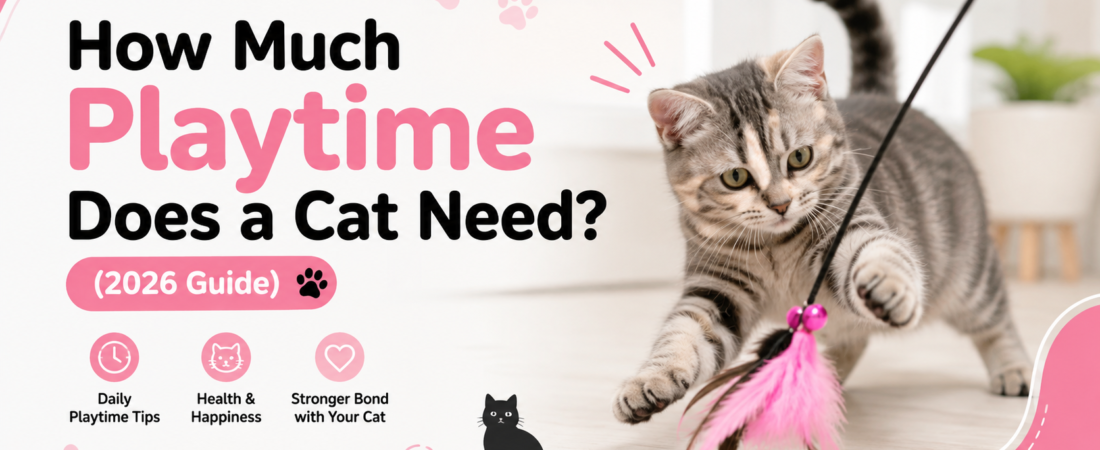
How Much Playtime Does a Cat Need? (2026 Guide)
Play is an important part of a cat’s daily routine. It helps cats stay active, mentally stimulated, and connected with their natural hunting instincts.
But how much playtime does a cat actually need each day?
The answer depends on your cat’s age, personality, health, and energy level. Some cats are happy with several short play sessions, while highly active cats may need more opportunities to chase, pounce, and explore.
In this guide, we’ll explain how much playtime a cat needs, how to build a simple daily routine, and how to tell whether your cat is getting enough stimulation.
Why Is Playtime Important for Cats?
Cats are natural hunters. Even indoor cats retain instincts to stalk, chase, pounce, and capture prey.
Regular play can provide several benefits:
- Supports physical activity
- Provides mental stimulation
- Helps reduce boredom
- Encourages natural hunting behaviors
- Can strengthen the bond between cats and owners
- Provides an appropriate outlet for energy
For indoor cats, play can be especially important because they may have fewer opportunities to explore and hunt naturally.
If you don’t want to constantly buy new toys, see our guide on How to Keep Cats Entertained Without Buying More Toys (2026 Guide).
How Much Playtime Does a Cat Need Every Day?
There isn’t one exact amount that works for every cat.
As a general starting point, many cats can benefit from two or more short interactive play sessions each day.
Rather than trying to keep your cat playing continuously, focus on short sessions that match their attention span and energy level.
For example:
Morning: 10–15 minutes of interactive play
Afternoon: Short independent enrichment activity
Evening: 10–15 minutes of interactive play
Some cats may want more, while others may prefer shorter sessions.
The goal is to provide regular opportunities for movement and mental stimulation.
Playtime for Kittens
Kittens typically have plenty of energy and curiosity.
They often benefit from multiple short play sessions throughout the day rather than one long session.
Kitten play can include:
- Chasing lightweight toys
- Batting balls
- Exploring tunnels
- Playing with supervised wand toys
- Climbing appropriate cat furniture
- Simple food puzzles
Avoid overwhelming a kitten with excessively long or intense sessions.
Because kittens frequently chew and investigate objects, make sure toys are appropriately sized and don’t contain easily detachable parts.
For more ideas, see our Best Kitten Toys in 2026: Complete Buying Guide.
Playtime for Adult Cats
Adult cats have different activity levels.
A young, energetic indoor cat may want several play sessions every day, while a calmer cat may be satisfied with shorter periods of interaction.
Try different activities and observe which ones your cat responds to.
Some cats enjoy:
- Chasing
- Pouncing
- Fetching
- Batting balls
- Puzzle feeders
- Wand toys
- Climbing
- Hide-and-seek games
The most effective play is usually the type your cat actually enjoys.
Playtime for Senior Cats
Senior cats may still enjoy play, but their physical abilities can change with age.
Gentler activities may be more appropriate.
Try:
- Slow wand movements
- Soft toys
- Easy food puzzles
- Short chasing games
- Gentle exploration
- Low climbing opportunities
Avoid forcing a senior cat to jump or run excessively.
If your cat suddenly becomes much less interested in play, discuss the change with a veterinarian, particularly if it occurs alongside other changes in behavior or mobility.
Signs Your Cat Needs More Playtime
Your cat may benefit from more stimulation if you notice behaviors such as:
- Excessive attention-seeking
- Increased nighttime activity
- Chasing your feet or hands
- Scratching furniture
- Knocking objects over
- Restlessness
- Repeatedly demanding play
- Losing interest quickly because activities are too predictable
These behaviors don’t always mean your cat needs more playtime. However, increasing appropriate enrichment can sometimes help.
Signs Your Cat Is Getting Enough Play
A well-stimulated cat may:
- Play enthusiastically during sessions
- Relax afterward
- Sleep normally
- Explore the environment
- Maintain interest in different activities
- Show normal appetite and behavior
Every cat is different, so focus on your cat’s normal behavior rather than comparing them with another cat.
The Best Time to Play With Your Cat
Cats are often naturally more active around dawn and dusk.
These periods can be useful opportunities for interactive play.
Try scheduling play sessions:
- Before breakfast
- In the late afternoon
- Before dinner
- In the evening
A play session followed by a meal can resemble a natural hunting sequence: stalk → chase → catch → eat → rest.
This routine may work particularly well for cats that become active or restless at night.
How Long Should One Play Session Last?
Short sessions are often easier for cats to engage with.
A session might last around 5–15 minutes, depending on the cat.
Some cats will remain interested longer, while others lose focus after only a few minutes.
You don’t need to force your cat to continue once they are clearly finished.
Several short sessions can be more effective than expecting your cat to play for a long uninterrupted period.
How to Make Playtime More Interesting
If your cat quickly loses interest, change the way you play.
Instead of constantly moving a toy directly in front of your cat, try creating realistic prey-like movements.
For example:
- Move the toy slowly.
- Hide it behind an object.
- Pause.
- Move it again.
- Allow your cat to chase.
- Let your cat catch the toy.
- End the session calmly.
This approach can make play feel more like a hunting experience.
For more ideas, see our How to Choose the Right Cat Toy (2026 Guide).
Rotate Your Cat’s Toys
You don’t need dozens of toys available at once.
Instead, keep a small selection accessible and store the rest.
Change the available toys every few days.
Toy rotation can help prevent familiar objects from becoming boring.
Read our How to Rotate Cat Toys to Prevent Boredom (2026 Guide) for more information.
What If My Cat Doesn’t Want to Play?
Some cats are naturally less playful than others.
Try different types of activities before assuming your cat isn’t interested in play.
For example:
- A food-motivated cat may prefer puzzle feeders.
- A hunting-focused cat may enjoy wand toys.
- A curious cat may enjoy boxes and tunnels.
- A high-energy cat may prefer chasing games.
- A calmer cat may prefer gentle interactive play.
If your cat suddenly stops playing when they previously enjoyed it, pay attention to other changes in behavior.
A sudden decrease in activity can sometimes be associated with discomfort or illness and may warrant veterinary advice.
Should You Play With Your Cat Every Day?
Yes, regular play is generally more useful than occasional long play sessions.
Try to make interactive play part of your cat’s daily routine.
Even a few minutes of focused interaction can provide useful stimulation.
Consistency matters more than having expensive toys or complicated activities.
Can Cats Play by Themselves?
Yes. Cats can enjoy independent activities such as:
- Safe balls
- Appropriate soft toys
- Scratching posts
- Cat tunnels
- Food puzzles
- Climbing structures
However, independent play shouldn’t completely replace interactive time with you.
Some toys, particularly those involving strings, ribbons, or small detachable parts, should only be used under supervision.
For safety guidance, see How to Choose Safe Cat Toys: 10 Safety Tips Every Cat Owner Should Know (2026 Guide).
A Simple Daily Cat Play Schedule
Here’s an easy routine you can try:
Morning
Spend 5–15 minutes using an interactive toy.
Follow the session with breakfast.
Afternoon
Provide independent enrichment such as a puzzle feeder, cardboard box, scratching area, or safe toy.
Evening
Have another interactive play session.
Try chasing, stalking, and pouncing games.
Before Bed
A short calm play session followed by food may help establish a predictable nighttime routine.
Adjust the schedule according to your cat’s age, energy level, and preferences.
Final Thoughts
So, how much playtime does a cat need?
There is no universal number. Many cats benefit from multiple short play sessions each day, with the exact amount depending on their age, personality, activity level, and physical condition.
Focus on quality rather than simply counting minutes.
Use interactive games, rotate existing toys, provide environmental enrichment, and give your cat opportunities to chase, stalk, pounce, climb, and explore.
A consistent daily routine can help your cat stay active, mentally stimulated, and happier indoors.
Related CatJoyLife Guides
- How to Keep Cats Entertained Without Buying More Toys (2026 Guide)
- How to Rotate Cat Toys to Prevent Boredom (2026 Guide)
- How to Choose the Right Cat Toy (2026 Guide)
- How to Choose Safe Cat Toys (2026 Guide)
- Best Kitten Toys in 2026: Complete Buying Guide
- Best Interactive Cat Toys for Indoor Cats in 2026
- Best Feather Wand Toys for Cats in 2026
- Best Puzzle Toys for Cats in 2026: Complete Buying Guide