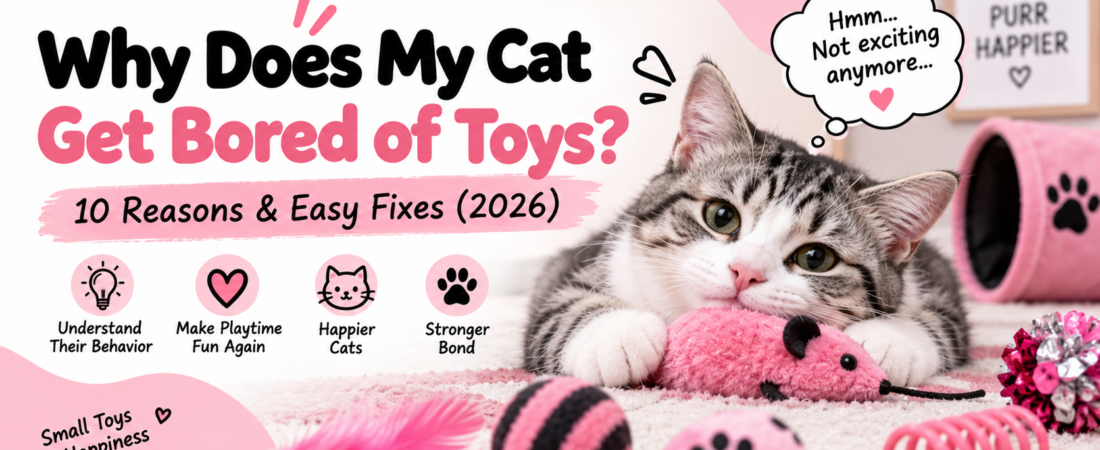
Why Does My Cat Get Bored of Toys? 10 Reasons & Easy Fixes (2026)
You buy your cat an exciting new toy, and for the first few days, they can’t get enough of it. Then suddenly, the toy sits untouched in the corner.
Sound familiar?
If your cat gets bored of toys, don’t worry. Cats naturally lose interest when toys become predictable or no longer trigger their hunting instincts.
The good news is that you don’t necessarily need to keep buying new toys.
Understanding why cats lose interest can help you make their existing toys exciting again.
Here are 10 common reasons your cat may become bored with toys—and what you can do about it.
1. Your Cat Sees the Same Toys Every Day
Imagine having every toy you own sitting in front of you 24 hours a day.
Eventually, they stop feeling special.
Cats can experience something similar.
When the same toys remain on the floor every day, they become part of the environment rather than something exciting to investigate.
What to Do
Try rotating your cat’s toys.
Keep several toys available and put the others away.
After a few days, switch them.
A toy your cat hasn’t seen for a week may suddenly feel new again.
For a complete strategy, read our How to Rotate Cat Toys to Prevent Boredom guide.
2. The Toy Doesn’t Move Like Prey
Cats are natural hunters.
Many of their favorite games imitate hunting behaviors such as:
- Stalking
- Chasing
- Pouncing
- Jumping
- Grabbing
- Biting
A toy sitting motionless on the floor may not trigger those instincts.
Interactive wand toys can be especially engaging because you control how they move.
Instead of waving the toy randomly, try moving it like prey.
Drag it slowly behind furniture, pause occasionally, and then make it suddenly move again.
This can make playtime much more interesting.
3. Your Cat Has Already Figured Out the Toy
Puzzle and interactive toys can provide mental stimulation.
But once your cat learns exactly how a toy works, the challenge may disappear.
For example, if your cat can remove treats from a puzzle feeder within seconds, the puzzle may no longer provide much enrichment.
Consider changing the difficulty or introducing a different challenge.
Our Best Puzzle Toys for Cats in 2026 guide explains what to look for when choosing puzzle toys.
4. You’re Choosing the Wrong Type of Toy
Not every cat likes the same toys.
One cat might love chasing feather wands while another prefers toy mice.
Some cats enjoy:
- Balls
- Springs
- Feather wands
- Toy mice
- Catnip toys
- Puzzle feeders
- Crinkle toys
- Tunnels
- Interactive toys
Pay attention to the movements that naturally attract your cat.
If your cat enjoys chasing objects across the floor, rolling or mouse-style toys may work well.
If they like jumping and catching objects in the air, wand toys may be more exciting.
See our How to Choose the Right Cat Toy (2026 Guide) for more ideas.
5. Play Sessions Are Too Long
More playtime isn’t always better.
Many cats prefer several short, exciting play sessions rather than one very long session.
A cat may play intensely for several minutes and then suddenly walk away.
That doesn’t necessarily mean they dislike the toy.
They may simply have finished that particular play session.
Try short sessions of around 5–15 minutes and adjust based on your cat’s age, energy level, and interest.
6. Your Cat Wants You to Participate
Some toys are designed for independent play, but many cats become more interested when their owner joins in.
A feather wand sitting on the floor isn’t particularly exciting.
A feather wand moving unpredictably around furniture is completely different.
Interactive play also gives you control over the speed and movement of the toy.
Try making the toy:
- Hide behind furniture
- Move slowly
- Suddenly run away
- Stop completely
- Change direction
- Disappear behind a box
The goal is to imitate the unpredictable movement of prey.
7. Your Cat Needs More Variety
Cats can become bored when every toy provides the same type of stimulation.
Instead of buying ten similar balls, consider providing different categories of enrichment.
For example:
Chasing: balls and toy mice
Hunting: wand toys
Mental stimulation: puzzle feeders
Kicking: kicker toys
Exploring: tunnels and boxes
Catnip play: catnip-filled toys
Different toys encourage different natural behaviors.
You can find more ideas in our Best Catnip Toys for Cats guide.
8. The Environment Is Too Predictable
Sometimes the problem isn’t the toy.
It’s the environment.
Cats benefit from opportunities to climb, hide, explore, scratch, watch, and hunt.
Simple household objects can sometimes provide excellent enrichment.
Cardboard boxes are a great example.
A box can become:
- A hiding place
- A hunting spot
- A nap area
- An exploration zone
- Part of an interactive game
If your cat seems more interested in the packaging than the expensive toy inside it, there’s actually a reason.
Read Why Do Cats Love Boxes? (2026 Guide) to learn more.
9. Your Cat Has Too Many Toys
This sounds surprising, but having too many toys available at once can make them less interesting.
When dozens of toys are scattered around the house, none of them feel particularly special.
Instead, keep a small selection available.
For example:
Week 1
- Wand toy
- Ball
- Toy mouse
- Puzzle toy
Week 2
- Spring
- Catnip toy
- Crinkle ball
- Different wand attachment
You don’t need to follow this exact schedule.
The goal is simply to create novelty without constantly buying new products.
For more ideas, see How to Keep Cats Entertained Without Buying More Toys.
10. Your Cat’s Preferences Have Changed
Cats’ play preferences can change as they age.
A kitten may happily chase almost anything that moves.
An adult cat may become more selective.
Senior cats may prefer slower, less physically demanding games.
That doesn’t mean older cats shouldn’t play.
Instead, adapt playtime to their abilities and preferences.
A senior cat might enjoy slowly chasing a wand toy across the floor rather than repeatedly jumping into the air.
Always consider your cat’s comfort and mobility when choosing activities.
How to Make Old Cat Toys Exciting Again
Before buying more toys, try refreshing the ones you already have.
Hide Them
Put toys away for several days or weeks before bringing them back.
Change the Location
Move playtime to another room or place toys near boxes and tunnels.
Add Movement
Turn a static toy into an interactive game.
Combine Toys
Use a ball inside a cardboard box or move a toy mouse through a tunnel.
Rotate Toys
Maintain a small active collection and regularly swap toys.
Use Catnip When Appropriate
Some cats respond strongly to catnip.
A small amount may make certain toys interesting again.
However, not all cats respond to catnip.
How Many Toys Does a Cat Need?
There isn’t a perfect number.
The quality and variety of enrichment matter more than filling your home with dozens of toys.
A practical collection might include:
- One or two wand toys
- Several small chase toys
- A kicker toy
- A puzzle or food-dispensing toy
- A catnip toy
- A tunnel or cardboard box
You don’t need to leave everything available at the same time.
Rotating a smaller collection can keep toys interesting for longer.
Signs Your Cat May Need More Stimulation
Cats can express boredom differently.
Possible signs include:
- Excessive attention-seeking
- Frequently waking you for play
- Attacking feet or hands
- Scratching inappropriate objects
- Excessive nighttime activity
- Constantly begging for food
- Restlessness
These behaviors don’t always mean boredom, and sudden behavioral changes can sometimes have medical causes.
If you’re concerned about a major change in your cat’s behavior, speak with your veterinarian.
Should You Buy Your Cat New Toys?
Sometimes, yes—but buying another toy shouldn’t always be the first solution.
Before purchasing something new, ask:
- Have I rotated the toys?
- Am I actively playing with my cat?
- Does this toy match my cat’s preferred hunting style?
- Does my cat have enough environmental enrichment?
- Can I make an existing toy more interesting?
If your cat genuinely needs something different, choose a toy that provides a type of stimulation missing from their current collection.
Frequently Asked Questions
Do cats get bored of their toys?
Yes. Cats can lose interest when toys become familiar or predictable. Rotating toys and changing how you use them can help restore interest.
How often should I rotate cat toys?
There is no strict schedule, but rotating toys every few days or weekly can work well for many cats.
Why does my cat play with a new toy for only one day?
Novelty can make a new toy exciting initially. Once the toy becomes familiar, your cat may lose interest, especially if it doesn’t provide interactive or unpredictable movement.
Why does my cat prefer boxes over expensive toys?
Boxes provide opportunities to hide, explore, stalk, scratch, and rest. These features can appeal strongly to natural feline behaviors.
Should I leave cat toys out all the time?
You can leave some safe toys available while storing others for rotation. This helps maintain novelty.
For safety, toys with strings, ribbons, feathers, or detachable small parts may require supervision and should be stored when you’re not present.
Final Thoughts
If your cat gets bored of toys, buying more isn’t always the answer.
Often, the best solution is to make playtime less predictable.
Rotate toys, imitate prey movements, experiment with different types of play, use boxes and tunnels, and participate in interactive play sessions.
Most importantly, pay attention to what your individual cat enjoys.
One cat might spend hours chasing a ball, while another would rather stalk a feather wand from behind a cardboard box.
Once you understand your cat’s preferred play style, keeping them entertained becomes much easier.
Continue reading our How to Choose the Right Cat Toy, How to Rotate Cat Toys to Prevent Boredom, Best Puzzle Toys for Cats, and How to Keep Cats Entertained Without Buying More Toys guides for more CatJoyLife playtime tips.