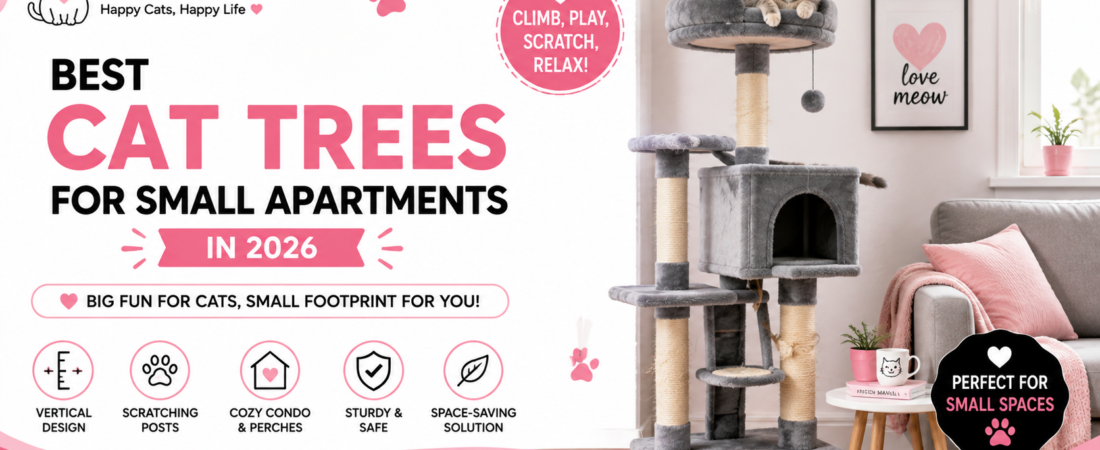
Best Cat Trees for Small Apartments in 2026
Living in a small apartment doesn’t mean your cat has to miss out on climbing, scratching, playing, and having a comfortable place to relax.
A well-designed cat tree can give your cat vertical space without taking up too much valuable floor space.
The key is choosing a cat tree that provides useful features while fitting comfortably into your apartment.
In this guide, we’ll explain how to choose the best cat trees for small apartments, what features to prioritize, and which designs work best when space is limited.
Why Do Cats Need a Cat Tree?
Cats naturally enjoy climbing and observing their surroundings from elevated positions.
A cat tree gives them a dedicated space for:
- Climbing
- Scratching
- Playing
- Sleeping
- Watching the room
- Hiding
- Stretching
For indoor cats, vertical space can be especially valuable.
If you’re still deciding whether your cat needs one, read Do Indoor Cats Really Need a Cat Tree?
What Makes a Cat Tree Good for a Small Apartment?
A large cat tree isn’t necessarily better.
For a small apartment, focus on vertical space rather than horizontal space.
A good compact cat tree should ideally provide several functions in one structure.
Look for:
- A small footprint
- Multiple levels
- Scratching posts
- A comfortable resting platform
- A stable base
- A cozy hiding area
- Durable materials
This allows your cat to enjoy several activities without requiring a large amount of floor space.
1. Choose a Tall, Narrow Design
One of the best strategies for a small apartment is choosing a tall cat tree with a relatively narrow base.
Instead of spreading across the floor, the structure uses vertical space.
Cats can climb upward while you preserve valuable walking and living space.
Before buying, measure the available area.
Don’t rely only on product photos.
Check the actual:
- Height
- Width
- Depth
- Base dimensions
A few centimeters can make a significant difference in a small room.
2. Look for Multiple Levels
Multiple platforms allow your cat to move vertically.
A compact cat tree can still have several levels without being extremely wide.
Different heights also give your cat options for:
- Watching the room
- Sleeping
- Jumping
- Climbing
- Playing
If your cat enjoys being high up, a taller model may be more useful than a wide model.
3. Don’t Forget Scratching Posts
A cat tree shouldn’t only be a climbing structure.
Scratching is a natural behavior for cats.
A good cat tree can combine climbing and scratching in one piece of furniture.
Look for scratching posts covered with durable materials such as sisal.
This can give your cat an appropriate place to scratch instead of using:
- Sofas
- Chairs
- Carpets
- Curtains
If scratching is a major concern, see our Best Cat Scratching Posts Guide.
4. Stability Is More Important Than Size
A compact cat tree still needs to be stable.
Cats jump onto platforms quickly, so a lightweight or poorly balanced structure can wobble.
When comparing models, consider:
- Base width
- Overall weight
- Construction quality
- Platform size
- Attachment points
- Whether wall anchoring is available
A taller cat tree should have an appropriately stable base.
Never choose a model simply because it is the tallest option.
5. Consider a Cat Tree With a Condo
A condo can provide your cat with a private resting area.
This is particularly useful in small apartments because it combines a hiding space and climbing structure in one piece of furniture.
A cat condo can become a place where your cat:
- Sleeps
- Hides
- Watches the room
- Takes a break
If your cat prefers enclosed spaces, prioritize a model with at least one comfortable hiding area.
6. Look for a Comfortable Top Platform
Many cats enjoy sleeping at the highest point of a cat tree.
A top perch gives them a good view of the surrounding area.
For a small apartment, one well-designed top platform can be more useful than several oversized platforms.
Make sure the perch is:
- Large enough for your cat
- Stable
- Comfortable
- Easy for your cat to reach
Larger cats may need wider platforms than kittens or small adult cats.
7. Think About Your Cat’s Size
The best cat tree for a small kitten may not be the best choice for a large adult cat.
Before buying, consider your cat’s:
- Weight
- Body size
- Age
- Activity level
- Climbing ability
If you have a large cat, don’t sacrifice platform size simply to save space.
A compact cat tree still needs to be comfortable.
For homes with more than one cat, read our guide to Best Cat Trees for Multiple Cats.
8. Choose the Right Location
Where you place the cat tree can make it much more useful.
Cats often enjoy locations where they can observe people and activity.
Good locations may include:
- Near a window
- In a living room
- Near a favorite resting area
- In a quiet corner
- Near a source of natural light
If your cat loves watching birds or outdoor activity, placing the cat tree near a secure window can make it more attractive.
However, make sure the structure doesn’t block doors, walkways, or emergency exits.
9. Window Cat Trees Can Save Space
A window-focused cat tree can be especially useful in apartments.
Your cat gets a high observation point without needing a huge amount of floor space.
Some compact designs are specifically made to fit near windows.
A window perch can also be used together with a smaller scratching tower.
This combination may provide more enrichment while using less floor space.
10. Consider a Multi-Function Cat Tree
When space is limited, every part of the furniture should have a purpose.
A good compact cat tree might combine:
Scratching post + climbing levels + sleeping platform + condo
This is more efficient than buying separate furniture for every activity.
You can also combine a compact cat tree with interactive toys.
See our Best Interactive Cat Toys Guide for additional ways to keep your cat active.
Small Cat Tree vs Large Cat Tree
Which one should you choose?
| Feature | Small Cat Tree | Large Cat Tree |
|---|---|---|
| Floor space | Low | High |
| Vertical space | Moderate–High | High |
| Best for | Small apartments | Large rooms |
| Multiple cats | Depends on design | Usually better |
| Portability | Easier | More difficult |
| Cost | Often lower | Often higher |
| Storage | Easier | More difficult |
For a small apartment, a compact vertical design is usually the better starting point.
How Tall Should a Cat Tree Be?
There isn’t one perfect height for every cat.
Consider your ceiling height and available space.
A taller structure can provide more climbing opportunities, but it also needs better stability.
Before purchasing, measure from the floor to the ceiling.
If you’re considering a tall model, leave enough clearance around it and follow the manufacturer’s installation instructions.
How to Make a Small Apartment More Cat-Friendly
A cat tree is only one way to add vertical enrichment.
You can also use:
- Window perches
- Wall-mounted cat shelves
- Scratching posts
- Cat tunnels
- Interactive toys
- Puzzle feeders
- Comfortable beds
Combining several small enrichment areas can be more effective than buying one enormous cat tree.
How to Keep a Small Cat Tree Interesting
Cats can lose interest if their environment never changes.
You can refresh the area by:
- Moving toys around
- Adding a new interactive toy
- Rotating toys
- Placing treats on different platforms
- Playing with your cat around the tree
- Adding a comfortable blanket
For more ideas, check How to Keep Cats Entertained Without Buying More Toys.
Common Mistakes When Buying a Cat Tree for an Apartment
Choosing Based Only on Height
A very tall cat tree isn’t useful if it is unstable.
Always consider the base and construction.
Ignoring the Measurements
Product photos can make furniture look smaller than it really is.
Measure your room before purchasing.
Buying a Cat Tree That Is Too Small
Saving floor space is important, but your cat still needs comfortable platforms.
Forgetting Scratching Areas
A cat tree without scratching surfaces may provide less value.
Placing It in an Unused Corner
Cats often prefer areas where they can observe people or windows.
Choose a location your cat actually enjoys.
Best Features Checklist
Before buying a cat tree for your apartment, check:
- Compact footprint
- Stable base
- Multiple levels
- Scratching posts
- Comfortable platform
- Suitable for your cat’s size
- Durable construction
- Appropriate height
- Easy to clean
- Fits your available space
You can also compare recommended products on our Cat Trees Products page.
Frequently Asked Questions
What is the best cat tree for a small apartment?
A tall, narrow, stable cat tree with scratching posts and at least one comfortable platform is usually a good choice.
Are cat trees worth it in a small apartment?
Yes.
A cat tree can provide vertical territory, exercise, scratching opportunities, and resting space without requiring a large amount of floor space.
How big should a cat tree be for one cat?
It depends on your cat’s size and activity level.
Even a compact model can work well if it provides enough room for climbing, scratching, and resting.
Can a large cat use a small cat tree?
It depends on the design.
Check the manufacturer’s weight limits and platform dimensions before buying.
Large cats need stable structures and sufficiently large platforms.
Where should I put a cat tree in a small apartment?
A living room corner or area near a secure window can work well.
Choose a location where your cat can observe the household while keeping the structure away from busy walkways.
Do cats prefer tall or wide cat trees?
Many cats enjoy height because it gives them a better view of their surroundings.
For small apartments, a tall and narrow design can therefore be especially practical.
Final Thoughts
The best cat trees for small apartments don’t need to be enormous.
The goal is to use vertical space efficiently while giving your cat opportunities to climb, scratch, play, hide, and rest.
Focus on stability, appropriate platform size, scratching areas, and a design that fits your available space.
Before purchasing, measure the area carefully and consider your cat’s size and personality.
A well-chosen compact cat tree can make a small apartment much more enriching for your cat without taking over your living space.
For more recommendations, visit our Products page and compare suitable options for your home.
This article is for general educational purposes and is not a substitute for veterinary advice. Always follow the manufacturer’s weight, installation, and safety recommendations.