Automatic cat feeders are usually designed around one simple job: dispensing dry kibble at scheduled times.
The Neakasa Riko takes a more ambitious approach.
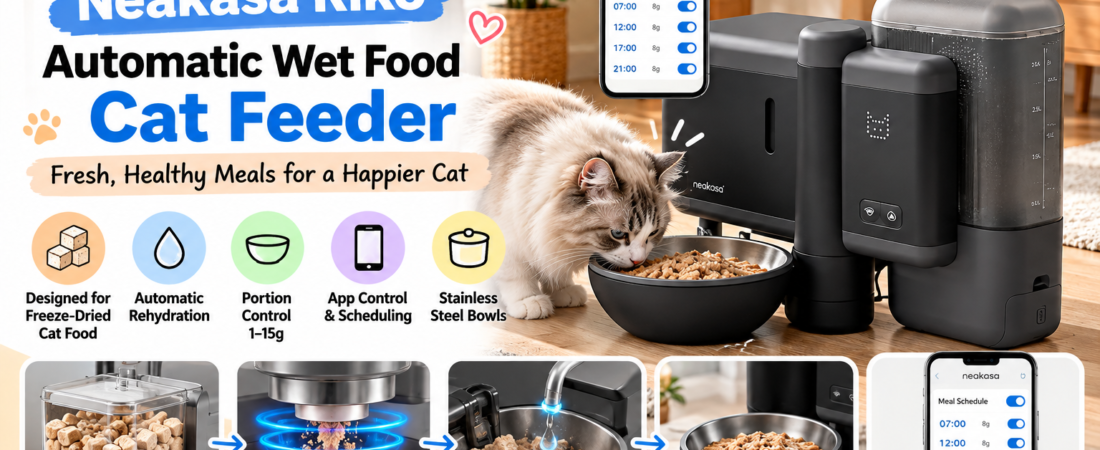
Instead of simply dropping food into a bowl, this automatic feeder is designed specifically around freeze-dried cat food, with a system that can grind the food and add water to rehydrate it before serving.
It also combines portion control, scheduled meals, app-based management, and a stainless steel feeding bowl.
For cat owners who already feed freeze-dried food, that could solve one of the biggest inconveniences: preparing and rehydrating individual meals throughout the day.
But the extra complexity also means the Riko isn’t a feeder that makes sense for every household.
Let’s look at what it does, where it could be useful, and what you should consider before buying.
Check Neakasa Riko Automatic Cat Feeder on Amazon →
Quick Overview
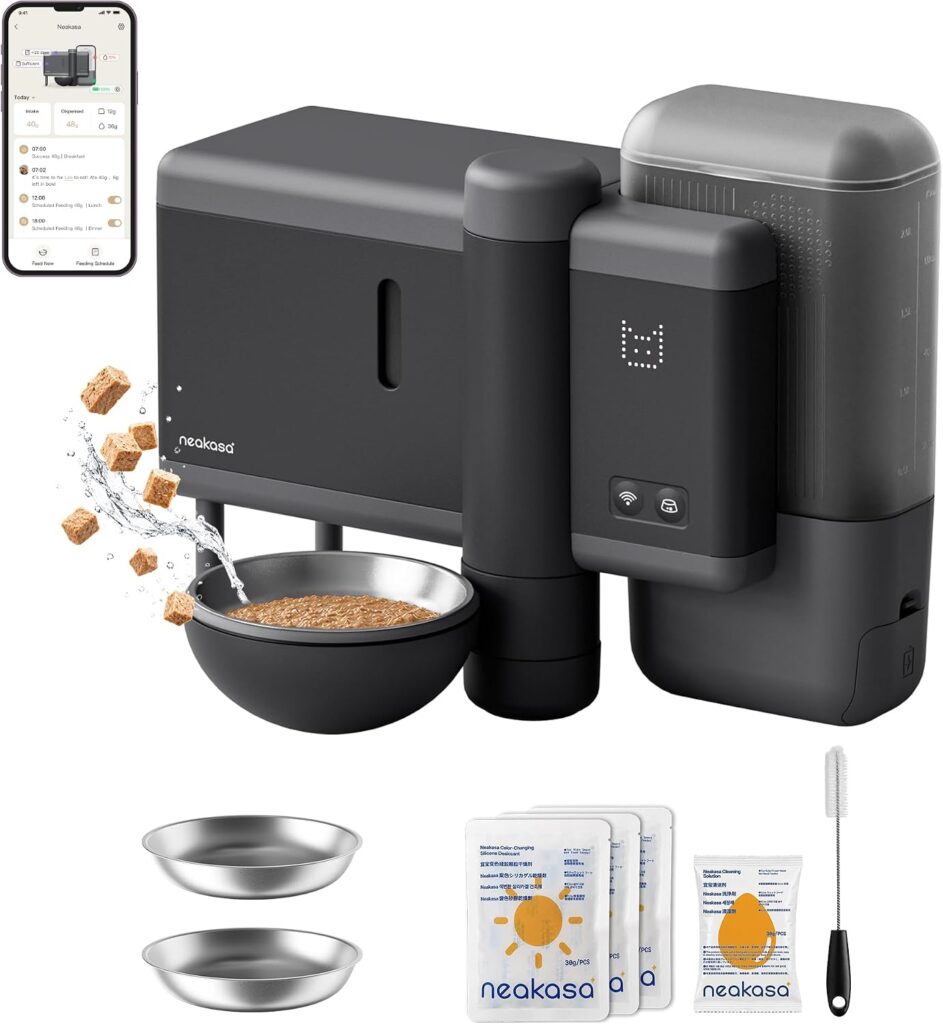
The Neakasa Riko is designed primarily for owners feeding freeze-dried cat food rather than standard dry kibble.
Based on the product listing shown, its notable features include:
- Automatic feeding
- Designed for freeze-dried cat food
- Food grinding
- Automatic rehydration
- Customizable water ratio
- App control
- Scheduled meals
- Small portion control
- Stainless steel bowls
- Freshly prepared meals
- Multi-meal scheduling
The major distinction is rehydration.
Instead of simply dispensing dry pieces, the machine is designed to prepare a meal closer to how many owners manually serve freeze-dried food.
If you’re still deciding what type of food is suitable for your cat, see Best Cat Food Guide (2026): How to Choose the Right Food for Your Cat.
Designed for Freeze-Dried Cat Food
Freeze-dried cat food is different from ordinary kibble.
Moisture is removed during processing, producing lightweight pieces that can be stored and served conveniently.
Some products can be served dry, while others are commonly rehydrated before feeding depending on the manufacturer’s directions.
The problem is convenience.
If you’re adding water manually for every meal, using an ordinary automatic kibble feeder doesn’t reproduce the same preparation.
That’s the gap the Neakasa Riko attempts to fill.
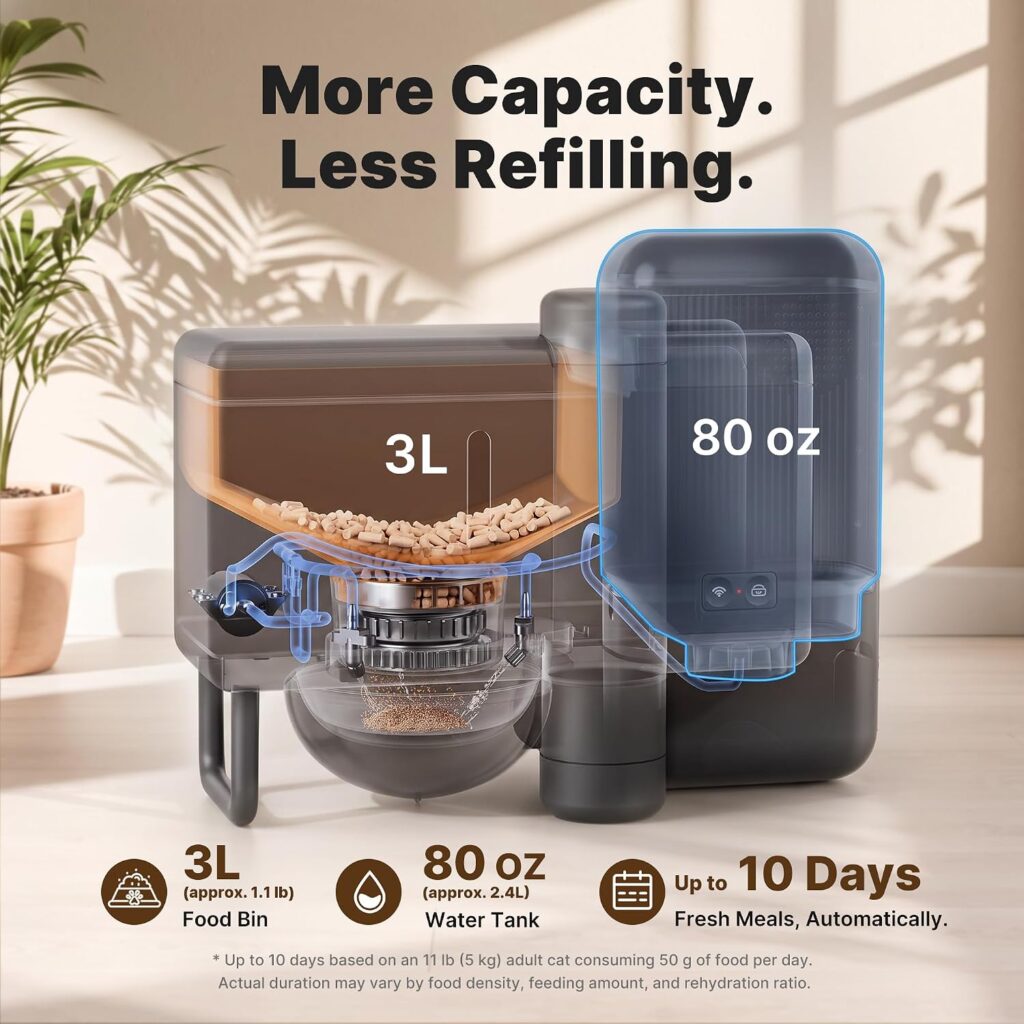
It stores food and water separately, then prepares the meal when required.
This makes it more specialized than a standard automatic feeder.
Automatic Grinding and Rehydration
This is the feature that makes the Riko genuinely different from most automatic feeders.
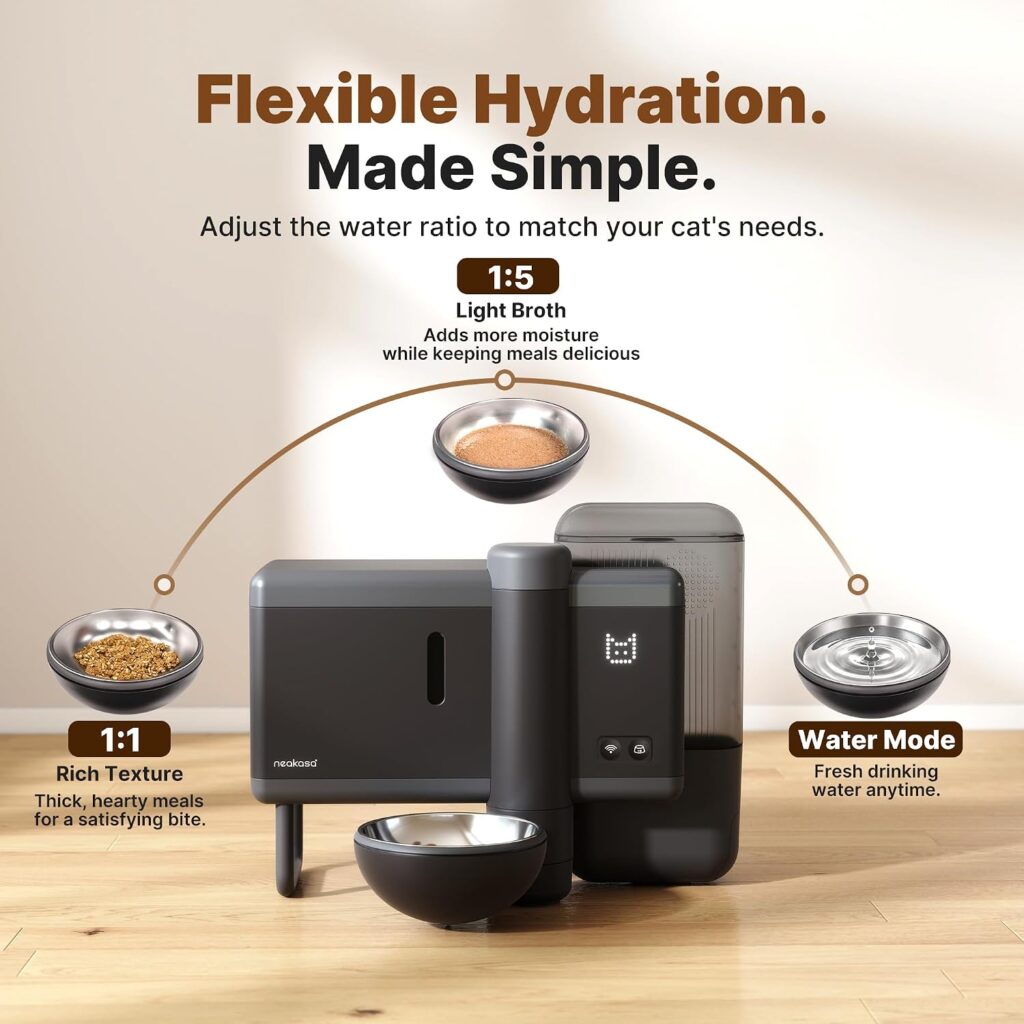
The system is designed to process freeze-dried food before serving and mix it with a selected amount of water.
That potentially provides two benefits.
First, it reduces the amount of manual meal preparation required from the owner.
Second, adding water increases the moisture content of the meal compared with serving the freeze-dried food completely dry.
However, there’s an important limitation:
The correct amount of water depends on the food you’re using.
You shouldn’t assume one water ratio is appropriate for every freeze-dried formula.
Follow the feeding and preparation instructions supplied by the food manufacturer.
Custom Water Ratio
The ability to adjust the water ratio is therefore one of the more useful features.
Different cats may also prefer different textures.
Some may prefer a thicker mixture, while others may accept food with more water.
Being able to adjust preparation gives owners more flexibility than a fixed dispensing system.
But don’t turn this into guesswork.
Start with the food manufacturer’s recommended preparation and adjust only when appropriate.
Portion Control
According to the product information shown, the Riko supports small controlled portions.
That can make scheduled feeding more precise than filling a large bowl and allowing free access throughout the day.
Portion control can be particularly useful when:
- Feeding several small meals
- Controlling daily food intake
- Establishing a predictable feeding routine
- Preventing the bowl from sitting full all day
However, portion size should ultimately be based on the calorie content of the specific food and your cat’s individual needs—not simply the number of portions selected in an app.
If you’re comparing nutrient density and protein levels, read Best High-Protein Cat Food in 2026: Benefits, Risks & Buying Guide.
Multiple Meals Per Day
The listing indicates support for scheduling numerous meals throughout the day.
This is potentially useful because some cats prefer smaller, more frequent meals rather than one or two very large servings.
Automation also means the feeding schedule doesn’t have to match your work schedule exactly.
For example, meals can potentially be prepared while you’re:
- At work
- Sleeping
- Away for part of the day
- Busy elsewhere in the house
That said, an automatic feeder shouldn’t be treated as a replacement for checking on your cat regularly.
App Control
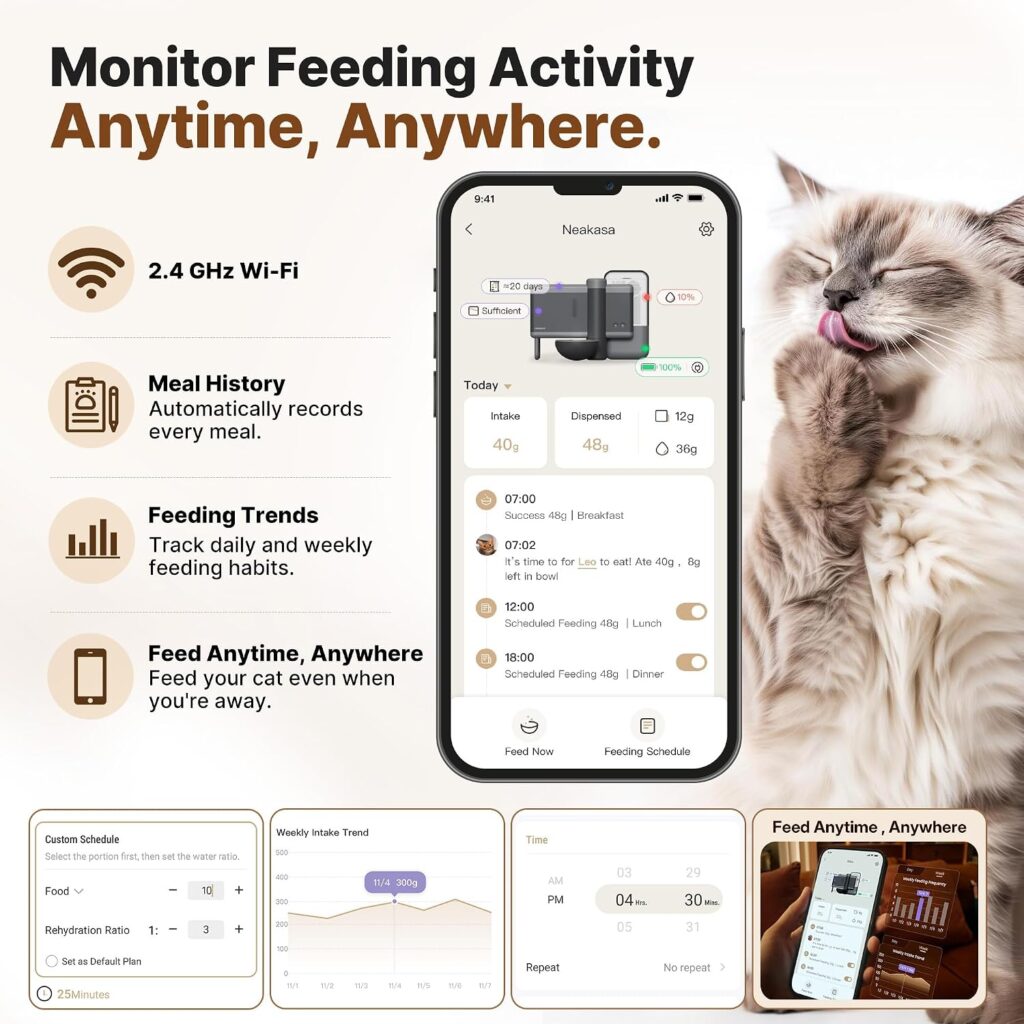
The Riko uses app connectivity for feeding management.
Depending on the current app functionality, this can allow owners to manage feeding schedules and preparation settings from their phone.
For someone who likes smart-home products, this can be convenient.
But app dependence is also a trade-off.
More technology means more potential points of friction:
- Wi-Fi configuration
- App updates
- Connectivity
- Account setup
- Software compatibility
If you only need a machine that releases dry kibble twice per day, the Riko may be unnecessarily complicated.
Its value comes from the specialized freeze-dried food preparation system.
Stainless Steel Feeding Bowls
The product shown includes stainless steel feeding bowls.
That’s a practical choice for the area that comes directly into contact with prepared food.
Because rehydrated food contains moisture, cleanliness becomes more important than with a simple dry-kibble dispenser.
Bowls should be washed regularly rather than continually topping them up.
Any remaining moist food should also be handled according to the food manufacturer’s storage and food-safety guidance.
This is another important distinction between the Riko and a standard kibble feeder:
Rehydrated food should not simply sit at room temperature indefinitely.
Does Rehydrating Freeze-Dried Food Matter?
It can.
Adding water obviously increases the amount of moisture consumed with the meal.
That’s one reason some owners prefer rehydrating freeze-dried food instead of serving it completely dry.
But avoid the common marketing leap that “more moisture automatically means this diet is healthier for every cat.”
The overall nutritional quality of the food still matters.
You need to consider:
- Complete and balanced nutrition
- Protein and fat content
- Calories
- Ingredients
- Life-stage suitability
- Your cat’s individual needs
The feeder prepares food.
It doesn’t make a poor-quality diet nutritionally complete.
How Easy Is It to Clean?
This is one of the areas I’d pay particular attention to before buying.
A normal automatic kibble feeder primarily handles dry food.
The Riko handles food + water + rehydrated food.
That creates more surfaces where food residue can potentially accumulate.
Regular cleaning is therefore essential.
Pay particular attention to:
- Feeding bowl
- Food outlet
- Grinding area
- Water-contact components
- Food-contact surfaces
- Water tank
Follow Neakasa’s cleaning instructions rather than assuming every component is dishwasher-safe.
A sophisticated feeder that isn’t cleaned properly can quickly lose much of its convenience.
Is It Suitable for Regular Dry Cat Food?
This is where buyers need to be careful.
The Riko is marketed specifically around freeze-dried food preparation.
If your cat eats ordinary dry kibble exclusively, you may not benefit from the features that justify the machine’s complexity and price.
A much simpler automatic feeder could perform basic portion dispensing for considerably less.
The Riko makes more sense when you specifically want:
Freeze-dried food + automatic preparation + rehydration + scheduled feeding.
Before purchasing, check the current manufacturer’s compatibility information for the exact food you plan to use.
Check Current Price on Amazon →
Pros and Cons
Pros
Designed specifically for freeze-dried food
This is its biggest differentiator from conventional automatic feeders.
Automatic rehydration
Reduces manual preparation for scheduled meals.
Food grinding system
Designed to prepare freeze-dried pieces before serving.
Adjustable water ratio
Allows more control over meal consistency.
App control
Useful for scheduling and managing feeding settings.
Portion control
Can help create more consistent feeding routines.
Multiple scheduled meals
Useful for cats that eat smaller meals throughout the day.
Stainless steel bowls
A practical material for food-contact surfaces.
Cons
More expensive than a standard automatic feeder
You’re paying for much more than basic food dispensing.
More components to clean
Food and water preparation requires more maintenance than dry-kibble dispensing.
Specialized use
Owners feeding ordinary kibble may not need most of its features.
App dependence
Smart functionality introduces another layer of setup and potential troubleshooting.
Prepared food requires attention
Rehydrated food shouldn’t simply remain in the bowl indefinitely.
Food compatibility matters
Not every freeze-dried product should automatically be assumed compatible with the grinding and dispensing mechanism.
Neakasa Riko vs. a Regular Automatic Feeder
A conventional automatic feeder usually does this:
Dry food → measured portion → bowl.
The Riko attempts to do:
Freeze-dried food → processing → water → rehydrated meal → bowl.
That’s a major difference.
A basic automatic feeder wins on simplicity and price.
The Riko wins on specialized meal preparation.
So asking whether Riko is “better” than a normal feeder misses the point.
The better question is:
Do you actually need automatic freeze-dried food preparation?
If the answer is no, much of what you’re paying for is unnecessary.
If you’re already manually preparing freeze-dried meals several times per day, the proposition becomes considerably more interesting.
Who Is the Neakasa Riko Best For?
This feeder may be particularly useful for:
- Cats regularly eating freeze-dried food
- Owners who normally rehydrate freeze-dried meals
- Busy cat owners
- People who feed several small meals per day
- Owners who want scheduled feeding
- People comfortable using app-controlled pet devices
It’s probably excessive for someone who simply wants to dispense ordinary kibble once or twice a day.
Is the Neakasa Riko Automatic Cat Feeder Worth It?
The strongest reason to consider the Riko is not that it’s an automatic feeder.
There are plenty of automatic feeders.
Its real selling point is the attempt to automate something conventional feeders generally don’t do well:
preparing rehydrated freeze-dried cat food.
If you already feed freeze-dried meals and regularly spend time measuring food, adding water and preparing multiple servings, the Riko could remove a repetitive part of that routine.
But that specialization is also its biggest limitation.
If your cat eats standard dry kibble, buying such a sophisticated system may make little financial sense.
The value therefore depends heavily on how you already feed your cat.
View Neakasa Riko Automatic Cat Feeder on Amazon →
Final Thoughts
The Neakasa Riko is an interesting example of an automatic feeder designed around a specific feeding style rather than trying to serve every cat owner.
Its combination of freeze-dried food processing, automatic rehydration, adjustable water ratio, portion control and app scheduling gives it capabilities that ordinary kibble feeders don’t offer.
The trade-off is greater cost and complexity.
You’ll need to maintain the water and food systems, clean food-contact components carefully, and make sure the freeze-dried food you use is appropriate for the machine.
For owners already committed to rehydrated freeze-dried feeding, those trade-offs may be worthwhile.
For everyone else, a simpler feeder may be enough.
For more nutrition and feeding information, visit Cat Food Guides.
Check Neakasa Riko Automatic Cat Feeder on Amazon →
Affiliate Disclosure
CatJoyLife may earn a commission from qualifying purchases made through affiliate links at no additional cost to you.