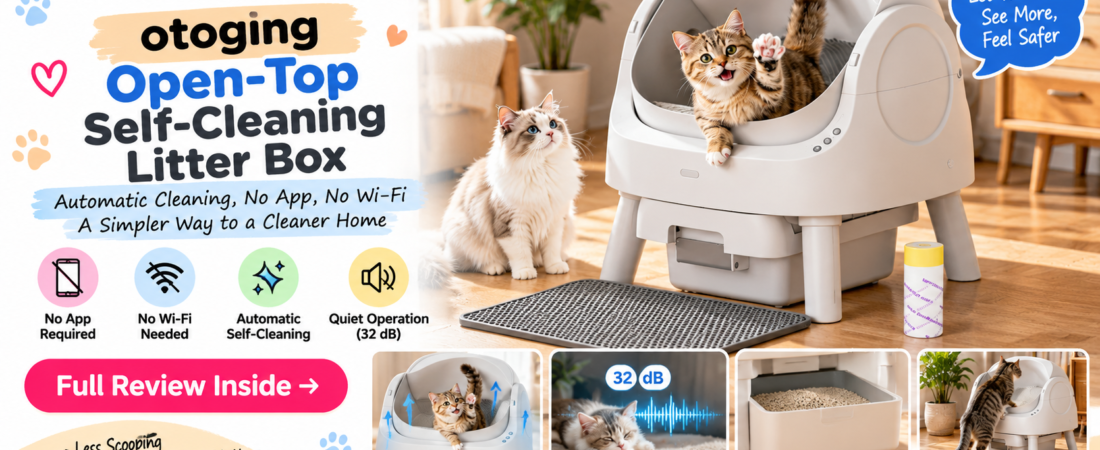
Automatic litter boxes can save time, but modern models often come with something not every cat owner actually wants: another app.
Wi-Fi setup, account registration, pairing problems, notifications, firmware updates, and smartphone controls can make a simple household task surprisingly complicated.
The otoging Open-Top Self-Cleaning Litter Box takes a different approach.
Instead of focusing on smart-home features, this model emphasizes automatic cleaning with simple plug-in operation and no app or Wi-Fi required.
It also uses an open-top design rather than the enclosed rotating drum found on many automatic litter boxes.
That combination could make it particularly interesting for owners who want automatic cleaning but don’t care about remote monitoring.
But simpler doesn’t automatically mean better.
Let’s look at where this litter box makes sense—and where its limitations are.
Check otoging Open-Top Self-Cleaning Litter Box on Amazon →
Quick Overview
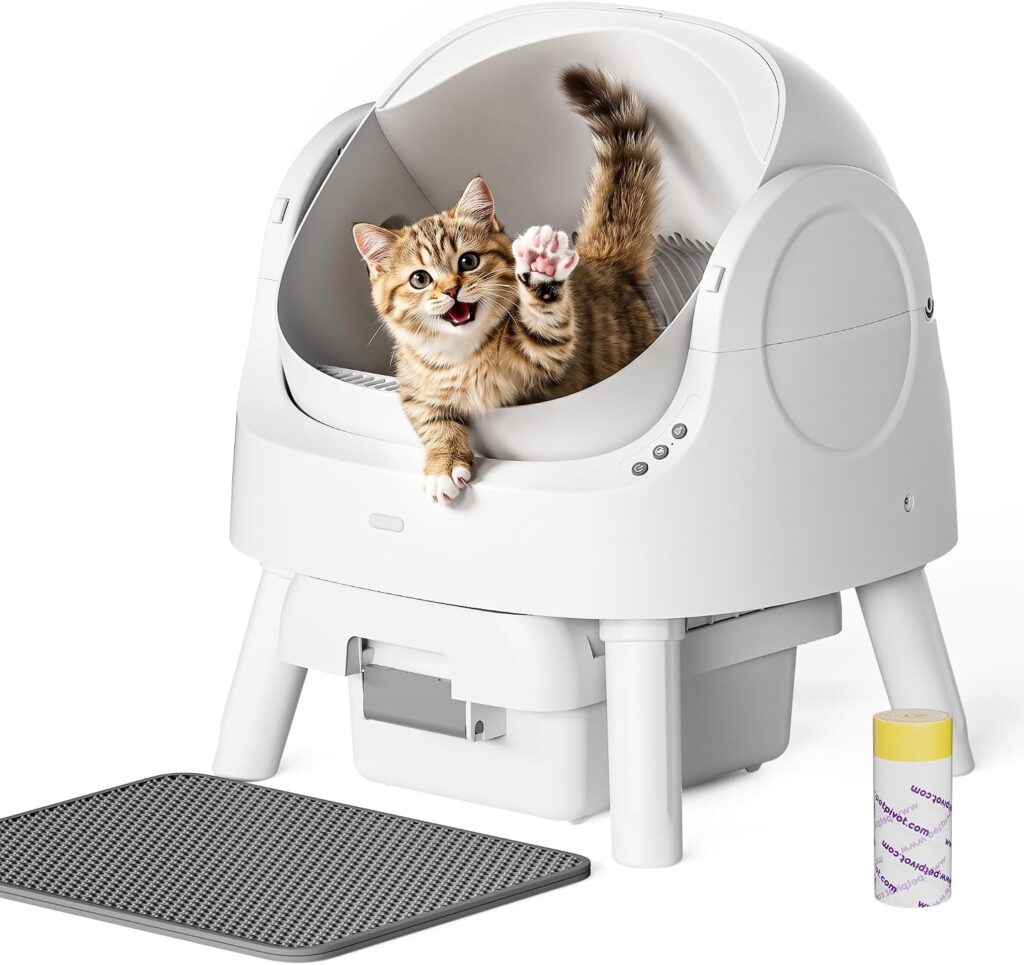
The otoging is an automatic litter box built around simplicity.
Based on the listing shown, key features include:
- Automatic self-cleaning
- Open-top design
- No app required
- No Wi-Fi pairing required
- Plug-in operation
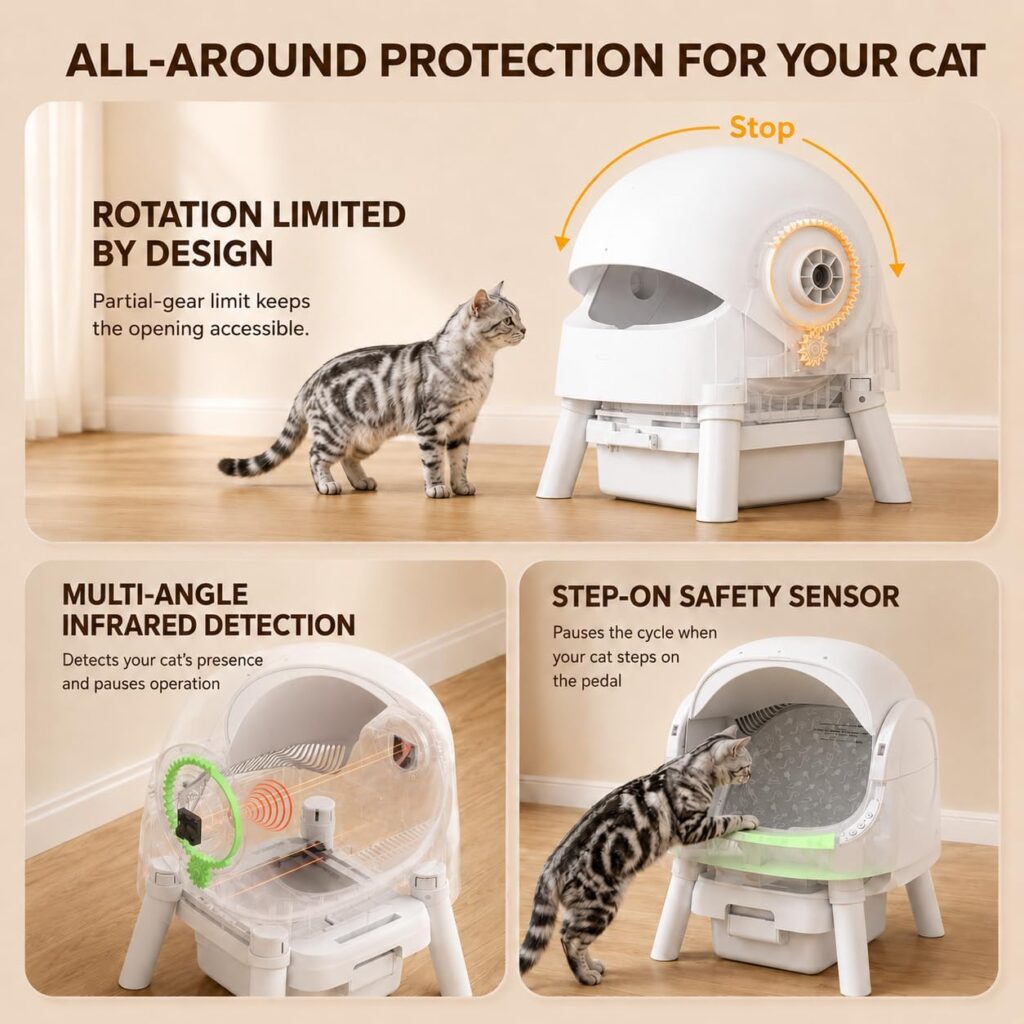
- Simple button controls
- Quiet operation advertised around 32 dB
- Waste collection compartment
- Litter-catching mat
- Designed to reduce manual scooping
Its biggest distinction isn’t a new smart feature.
It’s actually the absence of one.
Instead of making your phone part of the litter-box routine, this model attempts to automate cleaning while keeping controls relatively simple.
For general litter advice, see Cat Litter Guides.
Open-Top Design
The most visually obvious difference is the open entrance.
Many self-cleaning litter boxes use a relatively enclosed globe or drum. The cat enters through a circular opening and is surrounded by the machine while using it.
The otoging leaves much more of the top open.
That may appeal to cats that dislike feeling enclosed.
A more open design also gives a cat a clearer view of its surroundings while inside the litter box.
This shouldn’t be dismissed as cosmetic.
Some cats simply prefer open litter boxes.
If your cat already avoids covered conventional litter boxes, buying an expensive enclosed automatic machine could create an unnecessary transition problem.
No App and No Wi-Fi
This is arguably the product’s clearest selling point.
You don’t necessarily need an app for everything in your house.
The listing describes this model as requiring no app or Wi-Fi connection for normal operation.
Plug it in, use the physical controls, add suitable litter, and the cleaning system can perform its core function.
For some buyers, that’s a disadvantage because they want:
- Remote notifications
- Usage history
- Weight tracking
- Cleaning schedules
- Smartphone controls
But for other owners, removing those features is an advantage.
There are fewer connectivity steps and less dependence on a phone or cloud-connected service.
That makes this product meaningfully different from Cumrige Automatic Litter Box Review, which focuses much more heavily on app control and monitoring.
How Does the Self-Cleaning System Help?
The goal is straightforward: reduce daily manual scooping.
After the cat uses the litter box, the cleaning mechanism separates waste from reusable litter and moves the waste into a collection area.
You then empty the waste compartment periodically instead of manually scooping after every visit.
For busy owners, that’s the main value proposition of almost every automatic litter box.
But there’s a phrase worth remembering:
Self-cleaning does not mean maintenance-free.
You’ll still need to:
- Empty collected waste
- Refill litter
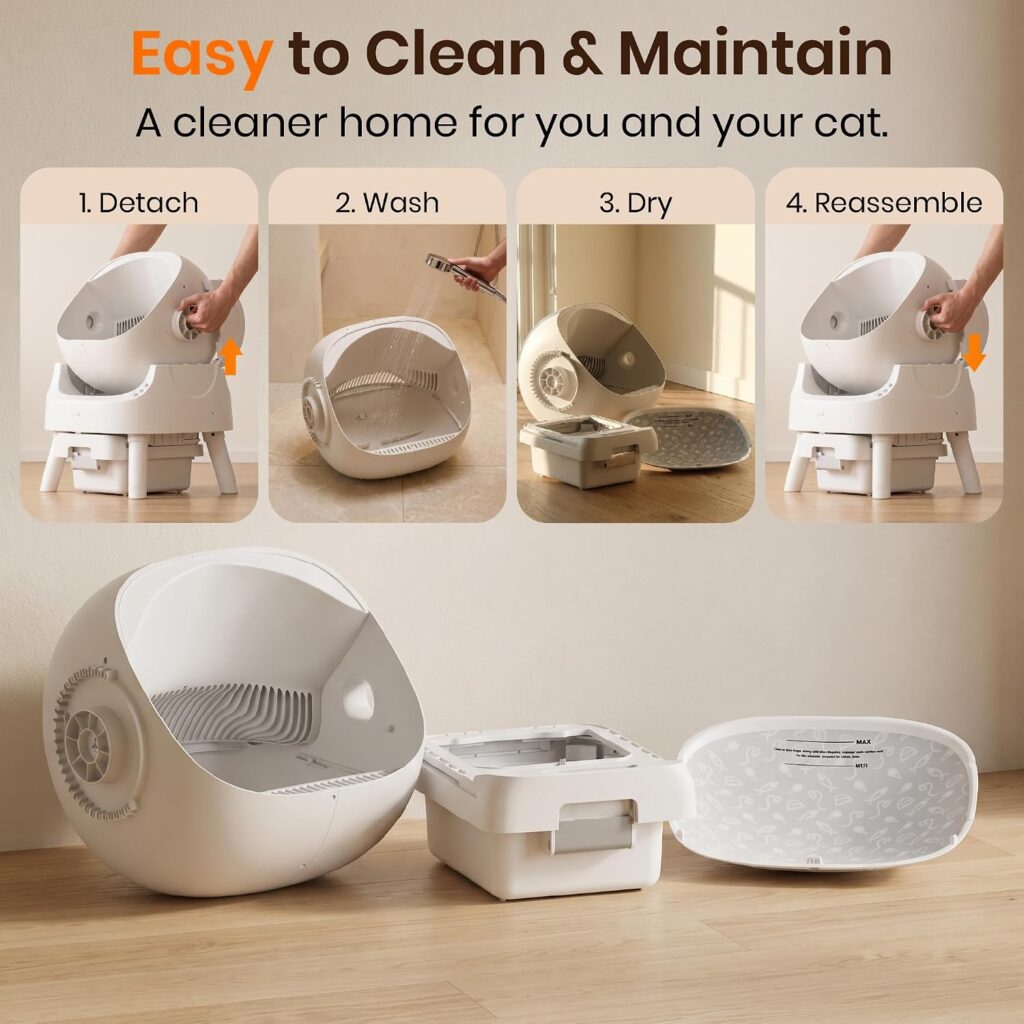
- Clean the interior
- Wipe surrounding surfaces
- Inspect the mechanism
- Replace waste bags when needed
- Perform periodic deeper cleaning
Automation reduces one repetitive job. It doesn’t eliminate litter-box hygiene.
Quiet Operation
According to the listing shown, the cleaning cycle is advertised at around 32 dB.
That’s potentially useful because mechanical noise can matter to both cats and owners.
A loud machine may be especially problematic if the litter box is located near a:
- Bedroom
- Home office
- Living room
- Quiet hallway
More importantly, a nervous cat may become suspicious of a litter box that suddenly makes loud mechanical noises.
However, don’t treat a manufacturer-provided decibel figure as a guarantee of how quiet the machine will feel in your particular room.
Flooring, litter, installation and mechanical vibration can affect perceived noise.
Why the Open Design May Matter for Cats
It’s tempting to evaluate automatic litter boxes entirely from the owner’s perspective:
“How much scooping does this save me?”
But the cat is the one who actually has to enter the machine.
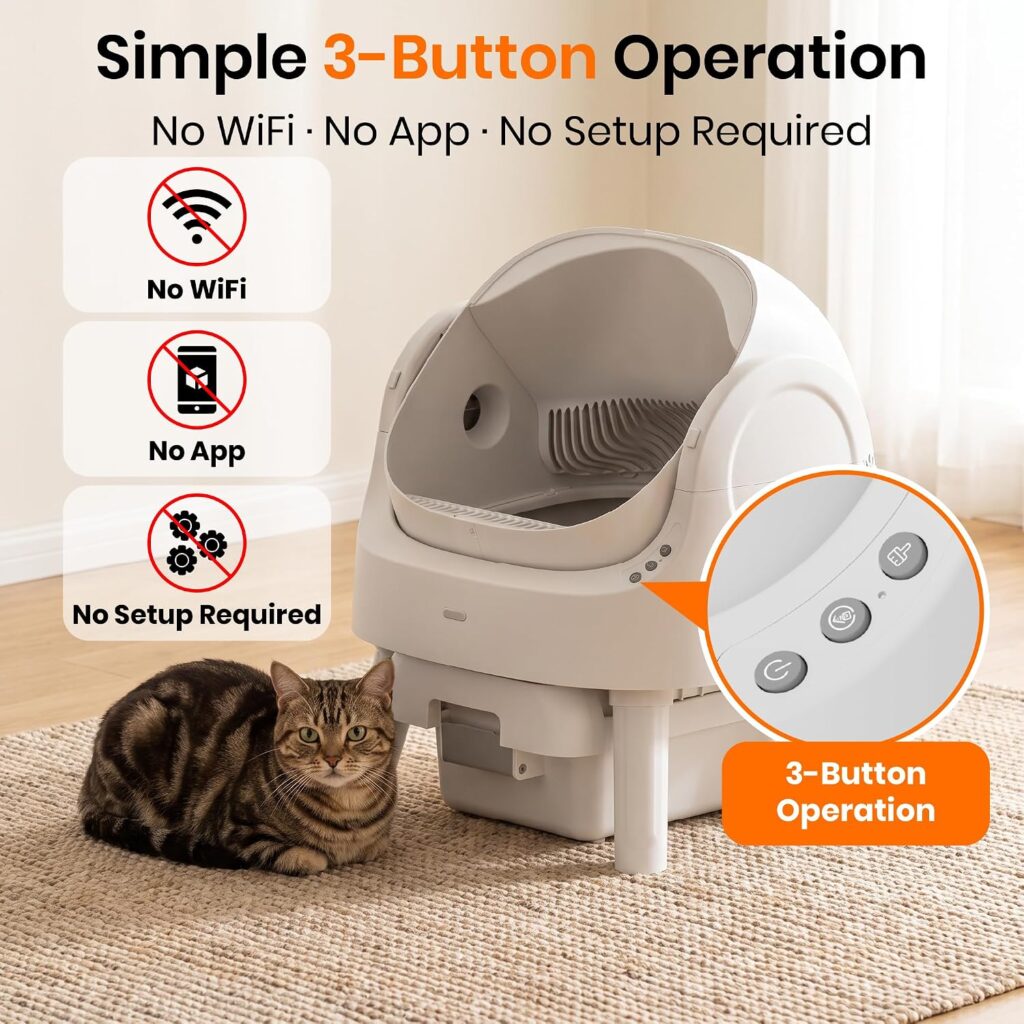
An open-top layout can provide:
- Easier visual access
- Less enclosed feeling
- A larger-looking entrance
- Easier entry and exit
- Better awareness of the surrounding room
That could make transitioning easier for some cats.
Still, every cat is different.
A cat that has used a traditional open tray for years may adapt quickly—or may remain suspicious simply because the new box moves.
The design reduces one potential barrier, not every barrier.
Waste Collection
The separated waste is stored below the main litter area.
This allows owners to empty accumulated waste periodically rather than manually scoop every clump immediately.
The actual interval between emptying depends on several factors:
- Number of cats
- Cat size
- Usage frequency
- Type of litter
- Waste volume
Be skeptical of any automatic litter-box claim that suggests one fixed emptying interval works for every household.
A two-cat household will usually fill a waste compartment faster than a single-cat household.
Does It Help Control Odor?
Automatic waste separation can potentially help because clumped waste isn’t left exposed in the main litter bed for long periods.
Moving waste into a separate compartment may reduce odor around the active litter area.
But the machine can’t fix poor litter-box maintenance.
You still need good litter and regular waste disposal.
For that reason, pair an automatic box with an appropriate litter rather than assuming technology alone will solve odor.
See Best Cat Litter for Odor Control in 2026 for your existing CatJoyLife guide.
What Litter Should You Use?
Automatic litter boxes generally work best when the litter can form suitable clumps that the cleaning mechanism can separate effectively.
Before using a particular litter, check the manufacturer’s current compatibility requirements.
Pay attention to:
- Clumping ability
- Particle size
- Recommended litter depth
- Materials the manufacturer says to avoid
Don’t assume every litter that works in an ordinary tray will perform equally well in an automatic machine.
You can also direct readers to Top 10 Best Cat Litter Brands in 2026.
Check Current Price on Amazon →
How to Introduce Your Cat to the otoging Litter Box
Don’t remove your cat’s old litter box on day one.
Cats can be highly sensitive to changes in where they eliminate.
A safer transition is:
- Place the new litter box near the existing one.
- Let your cat inspect it while it’s stationary.
- Add an appropriate familiar litter.
- Allow voluntary exploration.
- Avoid forcing your cat inside.
- Introduce the automatic cleaning cycle gradually.
- Keep the original box available until your cat consistently uses the new one.
If possible according to the manufacturer’s instructions, avoid triggering movement immediately after the cat’s first visit.
The objective is to prevent the cat from associating the new litter box with something frightening.
Pros and Cons
Pros
Automatic self-cleaning
Reduces the amount of routine manual scooping.
No app required
Useful for owners who don’t want another smartphone-controlled appliance.
No Wi-Fi setup
Removes connectivity and pairing from the basic setup process.
Open-top design
May feel less restrictive to cats accustomed to open litter trays.
Simple controls
Focuses on core litter-box functionality rather than extensive smart features.
Quiet operation
The listing advertises operation around 32 dB.
Waste collection system
Separates waste from the main litter area.
Cons
No remote monitoring
You sacrifice smart features found on more advanced automatic litter boxes.
No app-based health tracking
If weight and usage data are important to you, another model may be more suitable.
Still requires cleaning
Automatic scooping doesn’t eliminate maintenance.
More complex than a normal litter tray
Motors and electronics introduce components that can eventually require troubleshooting.
Requires power
Unlike a basic litter tray, automation depends on electricity.
Your cat still has to accept it
An open design can help, but there’s no guarantee every cat will use an automatic box.
otoging vs. Cumrige Automatic Litter Box
You now have both of these products on CatJoyLife, so link these two reviews together.
The difference is useful for buyers.
The Cumrige Automatic Litter Box emphasizes:
- App control
- Usage tracking
- Weight monitoring
- Large 95L capacity
- More smart features
The otoging emphasizes:
- No app
- No Wi-Fi
- Open-top design
- Simpler operation
- Automatic cleaning without extensive smart features
Neither approach is automatically better.
They’re aimed at different buyers.
If you want data and remote controls, the smart model has obvious advantages.
If your goal is simply “I don’t want to scoop every day”, paying for features you don’t intend to use may be unnecessary.
otoging vs. a Regular Litter Box
A basic litter tray remains difficult to beat for:
- Low price
- Simplicity
- Reliability
- Easy cleaning
- No electricity
The otoging’s reason for existing is convenience.
You’re paying more primarily to automate waste separation.
So don’t frame the buying decision as “automatic is always better.”
A better question is:
How much is reducing daily scooping worth to you?
For one cat and an owner who doesn’t mind scooping, a conventional box may remain perfectly adequate.
For someone who strongly dislikes daily scooping, the value calculation changes considerably.
Who Is This Self-Cleaning Litter Box Best For?
The otoging Open-Top Self-Cleaning Litter Box may be particularly suitable for:
- Owners who dislike daily scooping
- People who don’t want app-connected appliances
- Cats accustomed to open litter boxes
- Owners who prefer simple physical controls
- Homes where quiet operation matters
- People who want automation without extensive smart features
It may be less suitable for buyers specifically looking for detailed app-based monitoring and health data.
Is the otoging Open-Top Self-Cleaning Litter Box Worth It?
The most interesting thing about this litter box isn’t what it adds.
It’s what it deliberately leaves out.
Instead of packing the product with Wi-Fi, smartphone controls and monitoring features, the otoging focuses on automatic cleaning in a relatively straightforward open-top design.
For some buyers, that’s exactly the right compromise.
You get the main convenience of an automatic litter box—less manual scooping—without turning litter-box maintenance into another connected smart-home system.
But you’re giving up the remote monitoring and data features available from more sophisticated models.
If those features don’t matter to you, their absence isn’t really a disadvantage.
View otoging Open-Top Self-Cleaning Litter Box on Amazon →
Final Thoughts
The otoging Open-Top Self-Cleaning Litter Box offers a refreshingly straightforward approach to litter-box automation.
Its main strengths are automatic cleaning, open-top access, simple operation and no requirement for an app or Wi-Fi.
The open design may also appeal to cats that are hesitant about fully enclosed automatic litter boxes.
The trade-off is equally clear: buyers who want remote controls, weight tracking and detailed usage statistics should look at more advanced smart models.
For owners who mainly want to reduce scooping without adding another app to their phone, this simpler approach makes more sense.
For more litter-box advice and product reviews, visit Cat Litter Guides.
Check otoging Open-Top Self-Cleaning Litter Box on Amazon →
Affiliate Disclosure
CatJoyLife may earn a commission from qualifying purchases made through affiliate links at no additional cost to you.