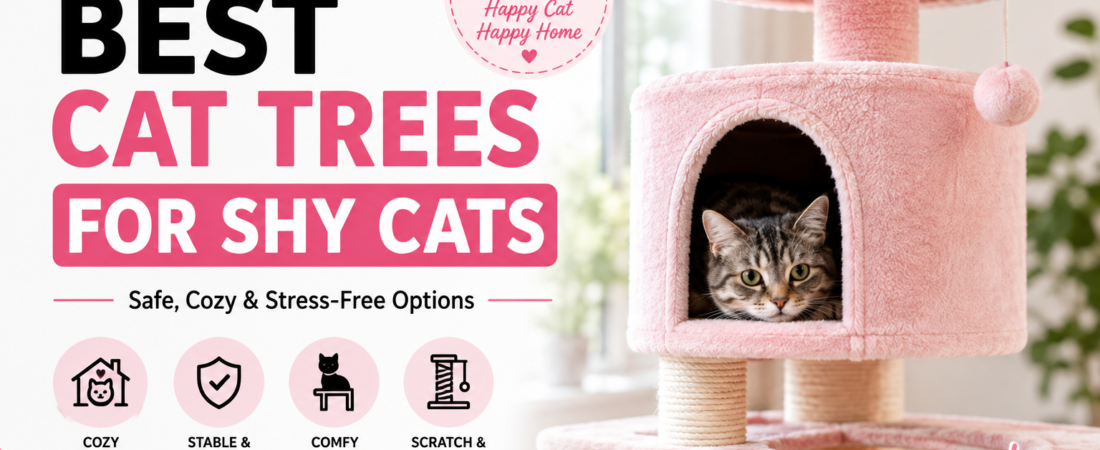
Best Cat Trees for Shy Cats in 2026: Safe, Cozy & Stress-Free Options
Not every cat is confident and outgoing. Some cats prefer quiet spaces, hide when visitors arrive, and need extra time to feel comfortable in a new environment.
For these cats, the best cat trees for shy cats can provide more than a place to climb. A well-designed cat tree can create a private retreat where your cat can rest, observe the room, and gradually become more comfortable.
In this guide, we’ll explain which features matter most when choosing a cat tree for a shy cat and how to make the setup feel safe and inviting.
Do Shy Cats Benefit From a Cat Tree?
Yes. A cat tree can be especially useful for shy or nervous cats because it gives them control over their environment.
Many cats feel safer when they can retreat to an elevated or partially enclosed location.
A suitable cat tree can provide:
- A private hiding area
- A comfortable sleeping spot
- An elevated observation point
- A dedicated scratching area
- A safe place away from busy household activity
If you’re still deciding whether a cat tree is worthwhile, read Do Indoor Cats Really Need a Cat Tree?
What Makes a Cat Tree Good for a Shy Cat?
Shy cats usually benefit from cat trees that emphasize security and comfort rather than excessive toys or complicated structures.
Look for these features:
1. An Enclosed Hideaway
An enclosed condo or cubby can be one of the most useful features for a shy cat.
It gives your cat a place to retreat when they feel overwhelmed by:
- Visitors
- Loud noises
- Other pets
- Children
- Household activity
The hideaway should be large enough for your cat to turn around and lie down comfortably.
2. A Quiet Resting Platform
Some shy cats prefer to hide, while others feel safer observing from a distance.
A raised platform can give your cat a good view of the room while keeping them away from busy floor-level activity.
Choose a platform that is wide enough for your cat to rest comfortably.
3. A Stable Structure
A nervous cat may avoid a cat tree that moves or wobbles.
A sturdy base is therefore extremely important.
The structure should remain stable when your cat climbs, jumps, or moves around.
For more advice about stability and other buying factors, see How to Choose the Right Cat Tree.
Should a Cat Tree for a Shy Cat Be Tall?
Not necessarily.
Some shy cats enjoy being high above the activity, while others prefer staying closer to the ground.
The ideal height depends on your individual cat.
For a timid kitten or older cat, a lower structure may be easier to access.
For a confident climber who simply dislikes people, a taller cat tree with a secure upper platform may be ideal.
You can learn more about choosing the right height in How Tall Should a Cat Tree Be?
Why Enclosed Cat Tree Houses Can Help
A cat condo creates a small private space within a larger room.
This can be valuable for cats that need somewhere to retreat without completely isolating themselves.
A good enclosed area should:
- Have one or more accessible entrances
- Be large enough for comfortable movement
- Have a soft interior
- Be positioned away from excessive noise
- Allow your cat to leave easily
Don’t force a shy cat into the enclosed space. Let them discover it naturally.
Where Should You Put a Cat Tree for a Shy Cat?
Location is especially important for nervous cats.
A cat tree should ideally be placed somewhere your cat already feels relatively comfortable.
Good locations can include:
- A quiet corner of the living room
- Near a window
- Beside a familiar sleeping area
- Away from loud appliances
- Away from busy walkways
Avoid placing the cat tree directly beside a door that opens frequently or in the middle of heavy foot traffic.
For more placement advice, read Where to Put a Cat Tree?
Should You Put a Cat Tree Near a Window?
A window can be an excellent location for some shy cats.
From an elevated perch, your cat can observe birds, people, outdoor activity, and natural light while remaining safely indoors.
However, not every shy cat will enjoy a busy window.
If outdoor activity makes your cat nervous, choose a quieter window or another location where they can observe the room instead.
Best Cat Tree Features for Nervous Cats
When comparing cat trees, prioritize features that encourage security.
Cozy Hideouts
An enclosed sleeping area provides privacy.
Wide Platforms
Wide surfaces give your cat more room to relax without feeling unstable.
Soft Materials
Comfortable surfaces can make the cat tree more appealing as a resting area.
Scratching Posts
A scratching post allows your cat to perform a natural behavior without leaving the cat tree.
Multiple Exit Routes
A nervous cat may feel uncomfortable if it has only one way out of an enclosed area.
Multiple access points can give your cat more control.
Cat Trees for Shy Cats in Small Apartments
Small homes can still provide excellent vertical enrichment.
If you have limited floor space, consider:
- Compact cat trees
- Corner designs
- Narrow vertical structures
- Wall-mounted options
- Cat shelves combined with a small cat tree
For more space-saving ideas, see Modern Cat Trees for Small Apartments.
Wall-mounted structures can also be useful, but installation needs to be secure. Our guide Wall-Mounted Cat Trees: Are They Worth It? explains the advantages and considerations.
How to Introduce a Shy Cat to a New Cat Tree
Don’t expect a shy cat to immediately climb onto a new structure.
A gradual introduction usually works better.
Step 1: Place It Near a Familiar Area
Put the cat tree somewhere your cat already spends time.
Step 2: Add Familiar Items
A blanket or bedding that smells familiar can make the structure feel less strange.
Step 3: Let Your Cat Investigate
Allow your cat to approach the structure voluntarily.
Step 4: Use Positive Reinforcement
You can place treats or favorite toys near the cat tree to encourage exploration.
Step 5: Don’t Force Interaction
Avoid picking up your cat and placing them on the cat tree.
The goal is to allow your cat to decide when the structure is safe.
Can a Cat Tree Reduce Stress?
A cat tree cannot guarantee that a shy cat will become less nervous.
However, providing a predictable personal space can help give your cat more control over where they rest and observe their environment.
A cat tree should be viewed as one part of a comfortable home environment rather than a solution for every behavioral issue.
If your cat suddenly becomes unusually fearful, hiding, or withdrawn, consider discussing the change with a veterinarian.
What Materials Are Best for Shy Cats?
Comfortable and familiar materials are generally a good choice.
Carpet
Carpeted platforms can provide a soft and warm resting surface.
Plush Fabric
Soft fabric can make sleeping areas more comfortable.
Sisal
Sisal is useful for scratching and stretching.
If you’re comparing different construction materials, see Wooden vs Carpeted Cat Trees.
How Many Cat Trees Does a Shy Cat Need?
One well-positioned cat tree may be enough for a single shy cat.
However, larger homes may benefit from multiple resting areas.
For example, you could have:
- One main cat tree in the living room
- A smaller perch in the bedroom
- A scratching post in another room
- A quiet hideaway away from household activity
The number of structures you need depends on the size of your home and your cat’s preferences.
For more guidance, read How Many Cat Trees Do You Need?
What If You Have Multiple Cats?
A shy cat may need its own retreat if other cats frequently occupy the main cat tree.
In multi-cat households, providing several elevated spaces can reduce competition.
A shy cat should have access to at least one location where it can rest without being constantly disturbed.
For more ideas, see Best Cat Trees for Multiple Cats.
Should Shy Cats Use Tall Cat Trees?
Some shy cats absolutely love high perches.
Height can give a cat a sense of distance from people, dogs, and other household activity.
However, a tall cat tree should always be stable and easy enough for your cat to navigate.
If your cat is older or has difficulty climbing, consider a lower structure or one with easier access.
How to Keep a Shy Cat’s Cat Tree Comfortable
Regular cleaning is important, but avoid making the cat tree smell completely unfamiliar.
Wash removable bedding according to the manufacturer’s instructions and regularly remove loose fur and debris.
Inspect the structure for:
- Loose screws
- Wobbly platforms
- Torn fabric
- Damaged scratching posts
- Broken toys
- Loose ropes
For a complete maintenance routine, see How to Clean and Maintain a Cat Tree.
Cat Tree vs. Simple Cat Hideaway
A cat tree and a simple hideaway serve slightly different purposes.
A cat tree provides opportunities for climbing, scratching, resting, and observing.
A simple hideaway focuses primarily on privacy and security.
For a shy cat, combining both can be ideal.
For example, a cat tree could include a lower enclosed condo and an upper observation platform.
This gives your cat the choice between hiding and watching what’s happening around the home.
Final Thoughts
The best cat trees for shy cats should provide security, comfort, stability, and choice.
Look for a sturdy structure with an enclosed hideaway, comfortable platforms, accessible levels, and a suitable scratching area.
Most importantly, give your cat time to become familiar with the new furniture.
A shy cat may take days or even weeks to fully explore a new cat tree. Patience and positive reinforcement are usually more effective than forcing interaction.
With the right location and design, a cat tree can become a trusted retreat where your cat feels comfortable, secure, and in control.