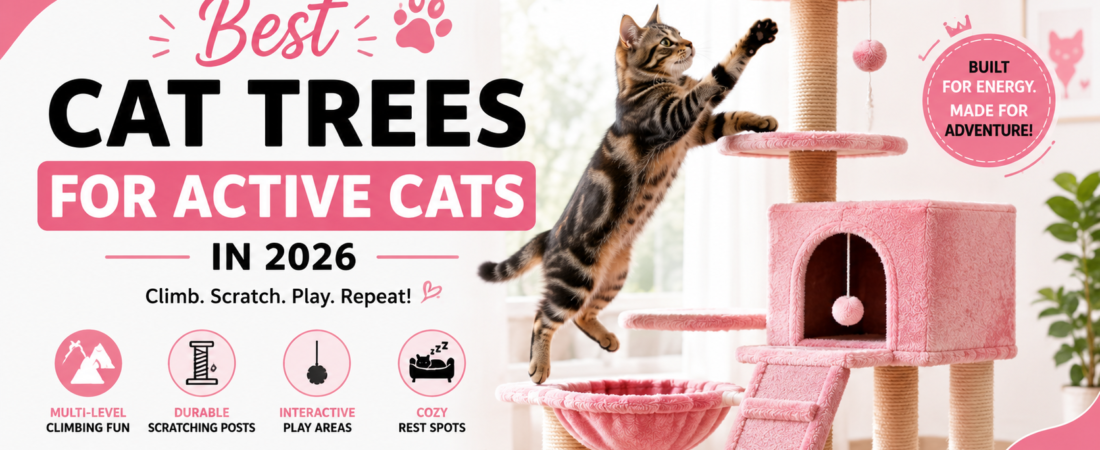
Best Cat Trees for Active Cats in 2026: Climbing, Scratching & Play
Active cats need more than a comfortable place to sleep. They need opportunities to climb, jump, scratch, play, and explore throughout the day.
Choosing the best cat trees for active cats can help provide this enrichment while giving your cat an appropriate place to burn energy indoors.
In this guide, we’ll explain which features matter most for energetic cats and how to choose a cat tree that can handle frequent climbing and play.
Why Do Active Cats Need a Cat Tree?
Cats naturally enjoy climbing, scratching, jumping, and exploring.
For an energetic indoor cat, a cat tree can provide a dedicated space for these behaviors without requiring your furniture to become the main playground.
A good cat tree can provide:
- Vertical climbing opportunities
- Scratching surfaces
- Multiple resting platforms
- Interactive toys
- Places to jump and explore
- A comfortable area for relaxing after play
If you’re still deciding whether your cat actually needs one, see Do Indoor Cats Really Need a Cat Tree?
What Makes a Cat Tree Good for Active Cats?
Active cats put more stress on cat furniture than cats that mainly sleep.
The best design should therefore combine stability, durability, height, and opportunities for play.
1. A Strong and Stable Base
This is one of the most important features.
An active cat may jump onto a platform at speed or move quickly between levels. A lightweight or poorly constructed cat tree can wobble during use.
Look for:
- A wide base
- Strong supports
- Secure connections
- Heavy-duty construction
- Platforms that don’t move when pushed
For a complete buying checklist, read How to Choose the Right Cat Tree.
2. Multiple Levels
Energetic cats often enjoy moving vertically.
Multiple platforms give your cat different routes to climb, jump, and explore.
A good layout may include:
- Lower platforms
- Middle resting areas
- Upper perches
- Scratching posts
- A hammock or bed
- An enclosed hideaway
However, more levels aren’t automatically better. The structure should remain stable and easy for your cat to navigate.
3. Durable Scratching Posts
Scratching is a natural part of feline behavior.
Active cats may use scratching posts frequently, so durability matters.
Sisal-wrapped posts are a popular choice because they provide a textured surface for scratching and stretching.
A good scratching post should also be tall enough for your cat to extend its body comfortably.
4. Interactive Toys
Some cat trees include hanging balls, ropes, or other toys.
These can encourage active play and make the structure more engaging.
However, inspect hanging toys regularly for damage and remove anything that becomes loose or unsafe.
Interactive toys should complement the structure rather than replace supervised play.
How Tall Should a Cat Tree Be for an Active Cat?
Active cats often enjoy taller structures, but height should never come at the expense of stability.
The ideal height depends on:
- Your cat’s age
- Size
- Jumping ability
- Confidence
- Available space
- Stability of the structure
If you’re comparing different heights, see How Tall Should a Cat Tree Be?
A tall cat tree can provide excellent vertical enrichment, but it should have secure platforms and a stable base.
Do Active Cats Need a Tall Cat Tree?
Not necessarily.
A shorter cat tree can still provide plenty of exercise if it has:
- Multiple levels
- Scratching posts
- Play areas
- Platforms
- Toys
- Good spacing between surfaces
For a small apartment, a compact vertical design may actually be more practical than a large floor-based playground.
See Modern Cat Trees for Small Apartments for more space-saving ideas.
Best Platform Layout for Active Cats
Platform arrangement can influence how much your cat uses the tree.
Platforms that are too close together may provide little climbing challenge.
Platforms that are too far apart may be difficult or unsafe to navigate.
A balanced layout gives your cat several ways to move around the structure.
Look for:
- Different platform heights
- Wide landing areas
- Secure transitions
- Scratching posts between levels
- A comfortable top perch
The goal is to create a vertical environment that encourages movement without creating unnecessary difficulty.
Cat Trees With Ramps vs Jumping Platforms
Ramps and platforms serve different purposes.
Platforms encourage jumping and climbing, which can be appealing to active cats.
Ramps provide a more gradual route between levels and may be useful for cats that don’t enjoy large jumps.
For a highly energetic cat, a combination of climbing platforms and accessible routes can provide more variety.
How Many Cat Trees Does an Active Cat Need?
One good cat tree may be enough for a single cat.
However, multiple structures can be useful in larger homes.
For example:
- One large cat tree in the living room
- A scratching post in the bedroom
- A window perch in another room
- Additional climbing shelves
Multiple locations give your cat more opportunities to move around the home.
For more guidance, see How Many Cat Trees Do You Need?
Best Cat Trees for Active Cats in Multi-Cat Homes
When several energetic cats share a home, competition for vertical space can become a problem.
Providing multiple climbing and resting areas can help each cat find its own space.
A larger cat tree with several platforms can be useful, but it should still provide enough room for individual cats to move comfortably.
For more information, read Best Cat Trees for Multiple Cats.
What Materials Are Best for Active Cats?
Durability is particularly important for energetic cats.
Sisal
Sisal is useful for scratching and can withstand regular use.
Wood
Wood can provide a strong structural foundation.
Carpet
Carpeted platforms provide traction and comfortable resting surfaces.
Plush Fabric
Plush areas can make sleeping platforms more comfortable, although they may require more frequent cleaning.
For a detailed material comparison, see Wooden vs Carpeted Cat Trees.
Are Tall Cat Trees Safe for Active Cats?
A tall cat tree can be safe when it is properly designed and secured.
Before buying, check:
- Base width
- Overall weight
- Platform size
- Construction quality
- Connection points
- Manufacturer weight recommendations
If the cat tree wobbles when you gently push it, it may not be suitable for a highly active cat.
Should You Secure a Cat Tree to the Wall?
For particularly tall structures or very energetic cats, additional stabilization can be useful.
Some cat trees include wall-anchoring hardware.
Follow the manufacturer’s installation instructions carefully and use appropriate hardware for your wall type.
This is especially important if your cat frequently launches onto upper platforms.
Where Should You Put a Cat Tree for an Active Cat?
Location can affect how attractive the cat tree is.
A good location may be:
- Near a window
- In a room where the family spends time
- Near existing play areas
- Away from fragile furniture
- In a space with enough room around the structure
A window location can provide additional visual stimulation from birds and outdoor activity.
For more placement ideas, read Where to Put a Cat Tree?
How to Encourage an Active Cat to Use a Cat Tree
Most energetic cats will naturally investigate an interesting structure, but you can make it even more appealing.
Try:
- Placing the cat tree near an existing favorite area.
- Adding a favorite toy.
- Playing with your cat around the structure.
- Using treats to encourage exploration.
- Placing a comfortable blanket on a resting platform.
Avoid forcing your cat onto the structure.
Let your cat discover the different levels naturally.
How to Maintain a Cat Tree Used by an Active Cat
Active cats can cause cat furniture to wear out faster.
Inspect the structure regularly for:
- Loose screws
- Wobbly platforms
- Torn fabric
- Damaged sisal
- Broken toys
- Loose ropes
- Cracked components
Clean accumulated fur and dust regularly.
For a complete maintenance routine, read How to Clean and Maintain a Cat Tree.
Signs Your Active Cat Has Outgrown Its Cat Tree
Your cat may need a larger or stronger structure if:
- Platforms have become too small
- The cat tree begins to wobble
- Your cat avoids certain levels
- Scratching posts are heavily worn
- Your cat can no longer comfortably stretch on the posts
- Resting areas are too small
Large breeds may require especially sturdy furniture.
If your cat is large, see Best Cat Trees for Large Cats.
Cat Tree vs Cat Wall for Active Cats
Both options can provide vertical enrichment.
A traditional cat tree is easier to move and usually requires less installation.
A wall-mounted system can provide more climbing routes while saving floor space.
For renters or owners who don’t want to drill into walls, a traditional cat tree may be more practical.
For a detailed comparison of wall-mounted designs, see Wall-Mounted Cat Trees: Are They Worth It?
How to Create an Active Cat’s Indoor Playground
A cat tree works best as part of a larger enrichment setup.
You can combine it with:
- Interactive toys
- Scratching posts
- Cat tunnels
- Window perches
- Puzzle feeders
- Cat shelves
- Daily play sessions
This creates multiple ways for your cat to stay active instead of relying on one piece of furniture.
Final Thoughts
The best cat trees for active cats should provide a combination of climbing, scratching, jumping, playing, and resting opportunities.
Prioritize a sturdy base, durable materials, secure platforms, useful scratching posts, and a layout that encourages movement.
A taller cat tree can be excellent for energetic cats, but stability should always come first.
With the right cat tree and additional enrichment activities, you can create a more engaging indoor environment that helps your cat stay active, entertained, and comfortable.