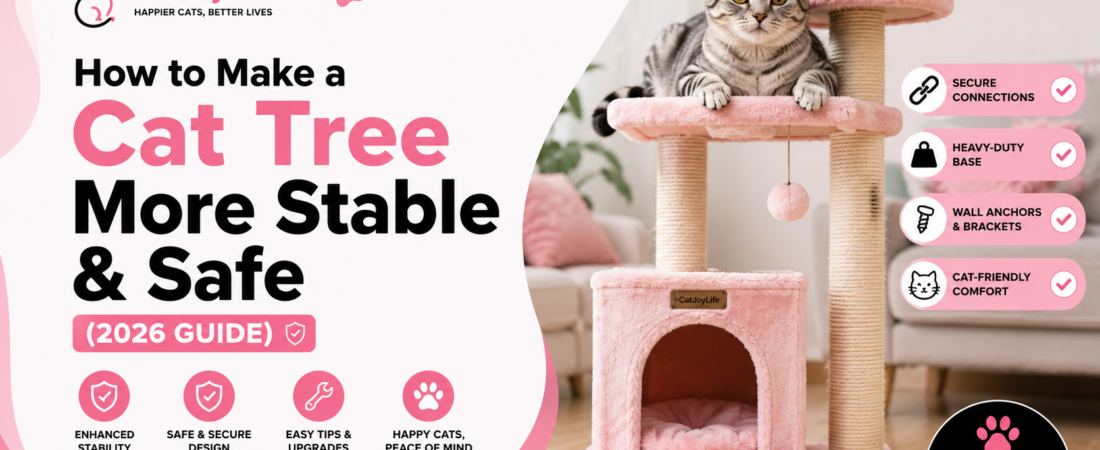
How to Make a Cat Tree More Stable and Safe (2026 Guide)
A cat tree can provide climbing, scratching, playing, and resting opportunities for indoor cats. However, even a well-designed cat tree can become unstable if it is placed incorrectly, assembled poorly, or used by a large and active cat.
Learning how to make a cat tree more stable and safe can help reduce wobbling and make the structure more comfortable for your cat to use.
In this guide, we’ll explain the most practical ways to improve cat tree stability, where to place it, how to inspect it, and when it may be time to replace it.
Why Is Cat Tree Stability Important?
Cats often jump onto cat trees at speed. An unstable structure may move, wobble, or tip when your cat climbs between platforms.
This can make the cat tree less appealing and may increase the risk of an accident.
Stability is especially important for:
- Large cats
- Active cats
- Multi-cat households
- Tall cat trees
- Older or less confident cats
- Cat trees placed on slippery floors
Before buying a cat tree, stability should be considered alongside size, materials, platforms, and scratching features.
Our guide How to Choose the Right Cat Tree covers the main factors to evaluate before purchasing.
1. Choose a Cat Tree With a Wide Base
The base is one of the most important parts of a stable cat tree.
A wider and heavier base generally provides better support than a narrow base, particularly when the structure is tall.
Look for:
- A broad bottom platform
- Strong supporting posts
- Heavy-duty construction
- Secure connections
- A base that sits flat on the floor
If the base is noticeably smaller than the upper structure, pay extra attention to stability.
2. Assemble Every Part Correctly
Poor assembly is one of the easiest ways to make a cat tree unstable.
Before allowing your cat to use it, check every screw, bolt, post, and connector.
Make sure:
- Screws are fully tightened
- Posts are correctly aligned
- Platforms are installed in the correct position
- No components are missing
- The base sits completely flat
After several days of use, inspect the connections again because repeated climbing and jumping can loosen hardware.
3. Place the Cat Tree on a Level Floor
Even a well-built cat tree can wobble if it sits on an uneven surface.
Choose a location with a flat floor whenever possible.
Avoid placing a tall cat tree on:
- Uneven flooring
- Thick soft rugs
- Sloped surfaces
- Unstable furniture
- Surfaces that move when your cat jumps
If you need to place it on a rug, make sure the base remains level and stable.
4. Use a Non-Slip Surface
A slippery floor can allow the entire cat tree to move when your cat jumps onto it.
A non-slip mat underneath the base may help reduce movement.
The mat should be large enough to support the base without creating an uneven surface.
This can be particularly useful on smooth flooring such as tile, laminate, or polished wood.
5. Secure Tall Cat Trees to the Wall
For particularly tall structures, wall anchoring can provide additional stability.
Many cat trees come with an anti-tip strap or wall attachment hardware.
Follow the manufacturer’s instructions carefully.
The correct anchor depends on the type of wall, so use hardware appropriate for the surface rather than assuming one type fits every wall.
This is especially useful if your cat frequently jumps onto the highest platform.
If you’re deciding how tall a cat tree should be, read How Tall Should a Cat Tree Be?
6. Don’t Put Heavy Objects on High Platforms
Avoid adding unnecessary weight to the upper levels.
Large decorative objects or heavy accessories can affect the balance of the structure.
Keep upper platforms primarily for your cat and lightweight accessories designed for cat furniture.
The lower portion of the structure should provide most of the support.
7. Choose the Right Size for Your Cat
A cat tree should be appropriate for your cat’s size and weight.
A small cat tree may not be suitable for a large breed, especially if the platforms are narrow.
Large cats may need:
- Wider platforms
- Stronger posts
- A heavier base
- Larger sleeping areas
- More durable construction
For large breeds, see Best Cat Trees for Large Cats.
8. Consider Your Cat’s Activity Level
An energetic cat can put significantly more stress on a cat tree than a cat that mainly sleeps.
If your cat frequently jumps, runs, and climbs, prioritize stability and durability.
Look for:
- Heavy bases
- Multiple support posts
- Reinforced platforms
- Durable scratching surfaces
- Secure connections
For more advice, read Best Cat Trees for Active Cats.
9. Make Sure Platforms Are Large Enough
Platforms should give your cat enough space to stand, turn around, and rest comfortably.
A platform that is too small can make climbing and landing more difficult.
This is particularly important for:
- Large cats
- Senior cats
- Cats with limited mobility
- Cats that sleep stretched out
For older cats, see Best Cat Trees for Senior Cats.
10. Keep Jumping Distances Reasonable
A cat tree should provide an accessible route between levels.
If platforms are extremely far apart, your cat may have difficulty moving safely between them.
Younger and active cats may handle larger jumps, but kittens and senior cats may benefit from shorter distances.
For kittens, read Best Cat Trees for Kittens.
11. Check the Cat Tree Regularly
Cat trees experience wear and tear over time.
Create a simple inspection routine and check:
- Screws
- Bolts
- Platforms
- Scratching posts
- Hammocks
- Ropes
- Hanging toys
- Fabric
- Base connections
If something becomes loose or damaged, repair it before allowing your cat to continue using the structure.
12. Replace Damaged Components
Some cat trees have replaceable scratching posts, cushions, or toys.
Replacing worn components can extend the life of the structure.
However, don’t continue using a cat tree if the main frame or structural supports are cracked, severely damaged, or unstable.
At that point, replacement may be safer than attempting a temporary repair.
13. Keep the Cat Tree Clean
Dust, fur, and debris can accumulate on platforms and inside enclosed areas.
Regular cleaning keeps the structure more comfortable and helps you identify damaged components.
Vacuum loose fur and clean removable cushions according to the manufacturer’s instructions.
For a complete maintenance routine, see How to Clean and Maintain a Cat Tree.
14. Avoid Placing the Cat Tree in a Dangerous Location
Location affects both stability and safety.
Avoid placing a cat tree:
- Directly beside fragile furniture
- Next to unstable shelves
- In a narrow walkway
- Near open flames
- Beside unsecured windows
- Where doors can hit the structure
A cat tree should have enough surrounding space for your cat to climb and move without colliding with nearby objects.
For more location advice, read Where to Put a Cat Tree?
15. Consider Multiple Cats
Multiple cats may use the same cat tree simultaneously.
This increases the load and can create more movement.
If you have several cats, choose a structure designed to support their combined activity and provide enough platforms for individual use.
You can also place additional scratching posts or climbing structures around the home.
For more ideas, see Best Cat Trees for Multiple Cats.
How to Tell If a Cat Tree Is Too Unstable
Some warning signs are easy to recognize.
Your cat tree may need attention if:
- It rocks when your cat jumps onto it
- The base lifts slightly from the floor
- Platforms move during use
- Screws repeatedly become loose
- Posts lean to one side
- Your cat suddenly avoids the structure
- You hear cracking or unusual movement
Don’t ignore repeated wobbling.
A cat tree that becomes unstable should be inspected before your cat continues using it.
Should You Put a Cat Tree Against a Wall?
Placing a cat tree near a wall can sometimes reduce the amount of space available for movement, but it may also make the structure easier to stabilize.
However, simply pushing a cat tree against a wall does not automatically make it safe.
If the manufacturer provides an anti-tip attachment, use it according to the instructions.
Leave enough space for your cat to access the platforms comfortably.
Is a Tall Cat Tree Less Stable?
Not necessarily.
A well-designed tall cat tree can be very stable.
However, taller structures generally have a higher center of gravity, so the base and construction become increasingly important.
When choosing a tall model, pay attention to:
- Base dimensions
- Overall weight
- Support posts
- Platform placement
- Wall anchoring options
- Recommended cat weight
If you’re deciding whether a tall structure is suitable for your home, see How Many Cat Trees Do You Need?
How to Make an Existing Cat Tree More Stable
If your cat tree is slightly wobbly but structurally sound, you can start with simple improvements:
- Tighten every connection.
- Check that the base is completely flat.
- Move it onto a more stable floor surface.
- Add a suitable non-slip mat underneath.
- Check whether any platform is incorrectly installed.
- Use the manufacturer’s anti-tip hardware if available.
- Replace damaged or worn components.
Avoid making permanent structural modifications that aren’t recommended by the manufacturer.
When Should You Replace a Cat Tree?
A cat tree should be replaced when its main structure can no longer provide reliable support.
Consider replacing it if:
- The frame is cracked
- Major posts are damaged
- The base is warped
- Platforms cannot be secured
- The structure repeatedly tips or wobbles
- Important hardware is missing and cannot be replaced
- The cat tree no longer supports your cat’s size
A worn scratching surface alone doesn’t necessarily mean the entire cat tree needs replacement.
Safe Cat Tree Checklist
Before allowing your cat to use a cat tree, check the following:
| Safety Check | What to Look For |
|---|---|
| Base | Wide, heavy, and level |
| Screws | Fully tightened |
| Platforms | Secure and large enough |
| Posts | Straight and firmly attached |
| Scratching areas | Secure and undamaged |
| Toys | No loose or broken parts |
| Floor | Stable and non-slip |
| Height | Appropriate for your cat |
| Wall anchor | Used when recommended |
| Surroundings | Free from hazards |
Final Thoughts
Knowing how to make a cat tree more stable and safe is an important part of responsible cat ownership.
Start with a strong base, correct assembly, a stable floor surface, and appropriate placement. For tall structures, consider using the manufacturer’s anti-tip hardware.
You should also inspect the cat tree regularly, especially if you have a large or active cat.
A stable cat tree doesn’t have to be complicated. The most important goal is to create a structure that your cat can confidently climb, scratch, play, and rest on every day.